Social Structure in South Indian Elephants

Guest post by Nandini Shetty

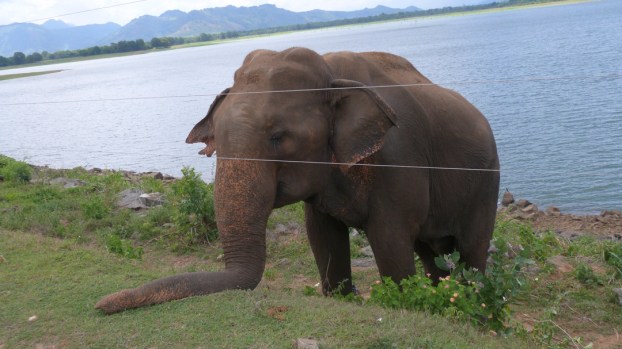
A group of elephants visit the grasslands surrounding the Kabini Reservoir in Southern India. Photo: Kabini Elephant Project

India includes some of the largest populations of Asian elephants in the world: an estimated ~26 000 to 28 000 elephants distributed across four regions. Of the four regions, southern India includes the single largest population of Asian elephants in the world (~14 000) and elephants are distributed across the Western and Eastern Ghats.

I studied the ecology and behaviour of Asian elephants as part of an ongoing long-term project on elephants, the Kabini Elephant Project, which was started in March 2009 to study the social life of elephants. Continue reading
Elephant Gardens

Guest post by Jessie Panazzolo

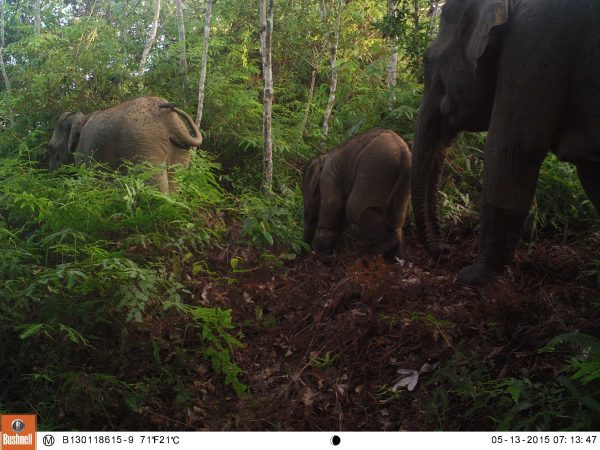
A camera trap photo shows Sumatran elephants trekking through lush regenerating forest.

I had always been told the same thing over and over again from my schooling, the scientific papers I read, and people I met growing up. This was that once primary rainforest was gone and removed from the Earth, it could not grow again. I was told that the forest needed a constant cycling of nutrients to flourish. That without the trees blanketing the ground in leaf litter the soil would be devoid of any nutrients needed to create such rich life again.

I had also been told that important forest dwellers such as the Sumatran Orangutan would only find a home in thick established forests. I had read in many different papers that Sumatran Orangutans, unlike their Bornean cousins, never spent any time walking on the forest floor in fear of the predatory Sumatran Tiger.

Considering all this, you could imagine my surprise and awe when I found myself in the middle of a brand new Sumatran rainforest, barely five years old, seeing orangutans walk the ground in front of my very eyes. It was then that I knew that anything was possible. Continue reading

News that caught our attention

Before we start, a disclaimer: there’s a lot of bad news out there. We’re not going to amplify it by reposting here. But we thought it would be nice to highlight interesting news every now and then. Things that give us hope (#ElephantOptimism) and/or make us think.

Here are a couple.

  1.  To bee (hive-fence) or not to bee (hive-fence)

Image: Bangkok Post

We recently published the results of a study done back in 2014 with Dr. Lucy King of the Elephants and Bees Project showing that Asian elephants are not very keen on bees (read the blog post here).  But of course, plenty of people had heard about the earlier studies with African elephants and had already jumped to the final step – beehive fences as a means of deterring crop raiding. Continue reading

The Secret Life of Elephants

We have the pleasure of watching elephants in broad daylight in precious few places like Udawalawe, where they are habituated enough to be placid and tolerant of onlookers. Indeed, one can get rather spoiled in this particular Park, because even the birds are unafraid and will happily sit and pose for your clumsy photograph from inches away. At times, certain exhibitionist pachyderms even appear to put on a show for the gawking crowds:

But all is not paradise. Continue reading

The Buzz about Elephants and Bees

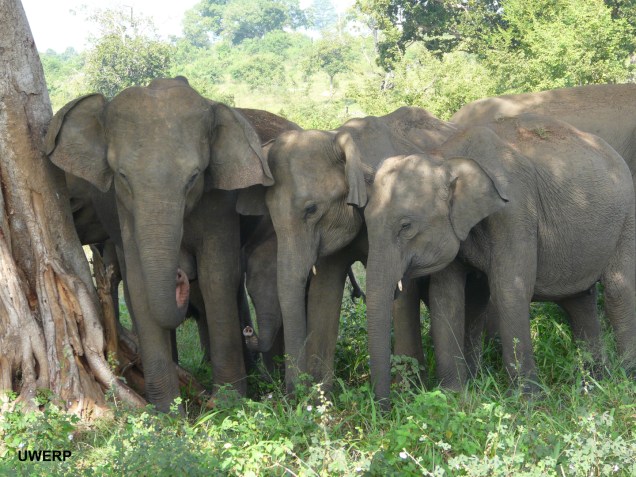
An elephant family rests under a tree in the hot midday heat. Situations like this were perfect for the playback experiments.

by SdS

In October 2007 Lucy King and colleagues first made a splash by reporting that African elephants seemed to be rather put off by bees.  I was still in Sri Lanka during my big “data collection year” as a graduate student, trying to figure out the social relationships among Asian elephants and recording vocalizations whenever I got a chance. Lucy’s first paper was a curiosity, but then three years later she followed it up with the even more intriguing finding that African elephants even produce alarm calls specific to bees. This got the attention of my advisor at Penn, Dorothy Cheney, who having expended considerable time thinking about such things as monkey alarm calls, dropped me a one-liner: “Have you seen this?” Continue reading

Sumedha’s Epic Musth

Sumedha shows all signs of musth as he consorts with Indika (Sandamali) in 2011, which include secretions from the temporal glands on the sides of his head and urine dribbling.

Of all the iconic tuskers that have passed through Udawalawe over the years, Sumedha is the one I’ve known longest. All tuskers are distinctive, because they’re so rare in Udawalawe, but Sumedha additionally had a nice big hole in his left ear and an awkward  tail with no hair. He wasn’t as regal as my beloved Raja, nor as old and wise as the Kalthota tusker, both of whom would have been easily dominant over him in the early years. But he was younger than either of them, and built like a tank. So if he survived, eventually his time would come. Continue reading

Evolving A More Egalitarian Elephant

coverphoto

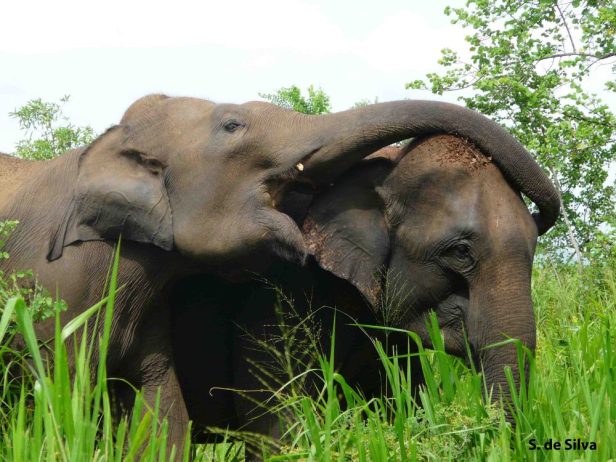
A young female named Right Hole puts her trunk over the head and back of another female of similar age with the ID [458]. The two are from different social groups, though they know each other.

Elephants are commonly thought to live in matriarchal societies which rely on the strong leadership and wisdom of elders, with strong age-based dominance hierarchies. Our new study in the journal Behavioral Ecology overturns this view, finding that in fact Asian elephants, unlike African savannah elephants (Loxodonta africana), do not exhibit clear dominance hierarchies or matriarchal “leadership” [1]. Continue reading

Collateral Damage Part 2 – Bycatch

By DJ & SdS

14192771_178500402579219_622052972801954950_n

In the fishing industry, the term “bycatch” refers to species that are entrapped in fishing nets that are not the intended target species.  Such victims, many of whom may die and simply be discarded overboard, represent a terrible waste of life.

Well, in Uda Walawe the bycatch this time was an elephant. Continue reading

Rambo, the Romeo

Guest post by Christin Minge

Rambo at his habitual location.

Rambo at his habitual location.

Male Asian elephants live rich social lives with a complex dynamic structure. They are often seen as solitary, but also frequently associate and interact with other males or female-groups depending on a variety of interconnecting factors, including life history, male dominance and alternative mating strategies, male and female sexual states and a complex feedback loop of social relationships with other elephants – just to name a few (Chelliah and Sukumar, 2013; 2015). The magnitude and consequences of sociality in male elephants are far from being explored yet, which is an emerging area of interest for the Uda Walawe Elephant Research Project. Simply speaking, mature males are expected to associate and interact with female-groups more during their reproductively active periods and are more solitary or in male-male associations during reproductively inactive periods. Continue reading

Collateral Damage Part 1 – Snares

By DJ & SdS

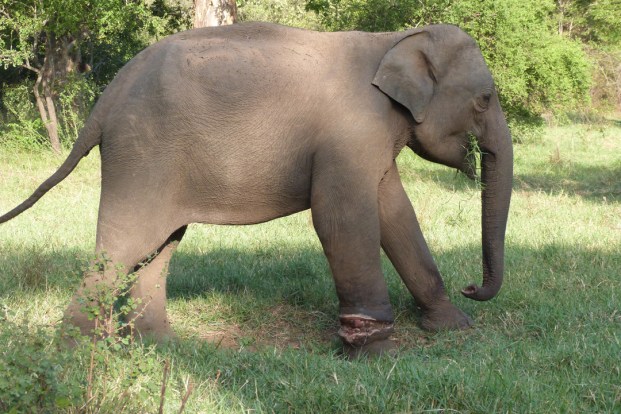
An adolescent at Minneriya National Park with a snare injury on his right foreleg.

An adolescent at Minneriya National Park with a snare injury on his right foreleg.

A snare is a hunting device resembling a wire noose. It’s the cheapest and easiest way to trap wild animals. In Sri Lanka, such poached bushmeat consists of wild boar, porcupine and lesser members of the deer family and is mostly locally consumed. Hunting non-protected species (wild boar and porcupine, which are considered as vermin) is not illegal but other species like deer are protected by the local Fauna and Flora Ordinance.

Locals say snare traps are often meant for wild boars. Unfortunately, these traps do not discriminate, they also make victims of species like leopard and elephant. During the last five years, more than ninety percent of the leopard deaths occurred in hill country, Sri Lanka was due to physical injuries of ensnaring. Our observations in Uda Walawe and Minneriya National Parks suggest that it is usually less-experienced juvenile elephants are the victims of snare traps, though adults may sometimes show signs of old wounds. Trunk injuries show the animals are vulnerable even during grazing, not just while walking. Perhaps calves’ natural curiosity makes them especially vulnerable. Continue reading