When Habitats Collide: Farming and Elephants at the Edge of Kuiburi National Park

By Lauren Sutton

It’s late evening in Ruam Thai village, just outside Kuiburi National Park in Prachuap Khiri Khan province, Thailand. On my laptop screen, camera trap videos flicker to life: an elephant (Elephas maximus) moving slowly across farmland, a farmer checking fields with a flashlight, the quiet tension of life lived at the forest’s edge.

Camera traps capture nighttime elephant movements through farmlands bordering Kuiburi National Park

This is what I have seen when assisting PhD researcher Sateesh Venkatesh to analyse camera trap footage from farms surrounding Ruam Thai. The village, established by the government, sits like an island, surrounded on three sides by national park. Families live clustered in the centre, while their fields spread outward, bordering the unfenced national park, it’s a layout that leaves farms vulnerable – and elephants know it.

Continue reading →
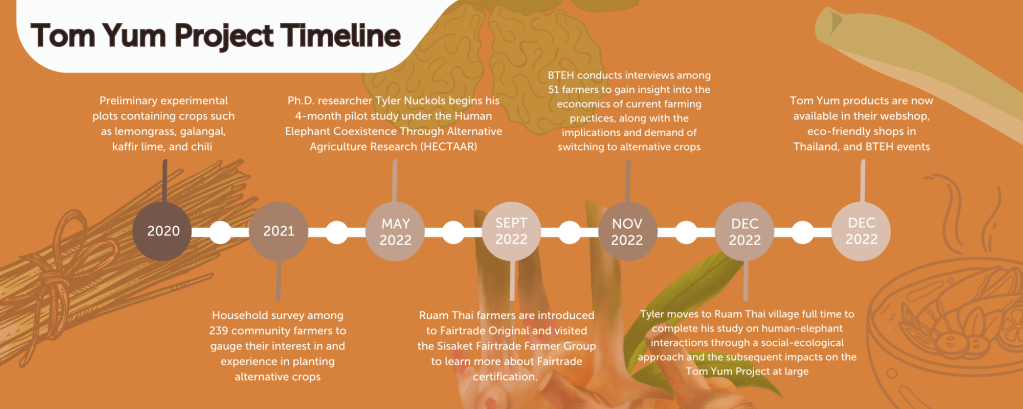
The Tom Yum project timeline: Facilitating human-elephant coexistence in Asia through planting unpalatable crops

Lemongrass, galangal, kaffir lime, and chili – these ingredients of the Tom Yum soup, a classic Thai dish, don’t simply remain in the bowl. They also play a role in facilitating human-elephant co-existence. Our partner in Thailand, Bring The Elephant Home (BTEH), began the Tom Yum project in 2020 to help support the local community by designing and implementing experiments using alternative crops that are unpalatable to roaming elephants. In 2022, we also welcomed PhD researcher Tyler Nuckols of The University of Colorado, Boulder in Ruam Thai for a first 4-month pilot study on the potential of alternative cropping as a method to promote human-elephant coexistence, which will contribute to the completion of their PhD dissertation. Three years after its conception, this project has grown from helping farmers alleviate economic losses to a profitable and eco-friendly venture. What’s going on in Ruam Thai nowadays?

Continue reading →