Stake-out, Part 1: Where did all the elephants go?

by SdS

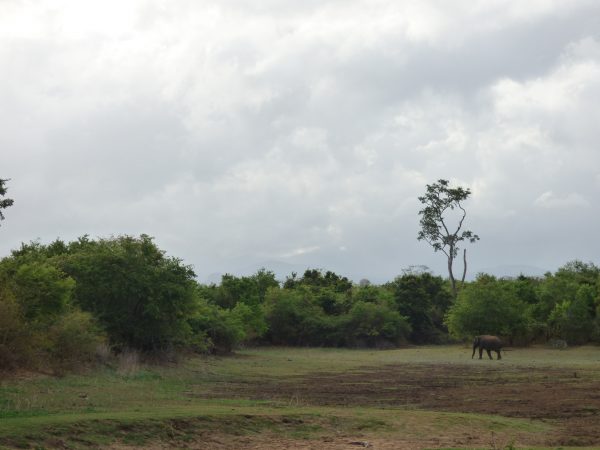
A lone male at the reservoir was all we saw…

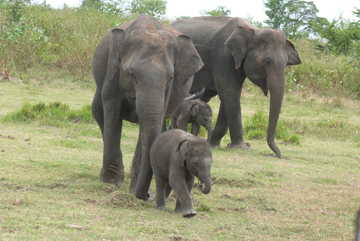
Back in 2007, 2008 and 2009 UWERP devoted intensive effort to surveying all parts of the park in order to make an estimate of the elephant population. Ten years on, it is time to re-do this exercise. What that means is that for a few specific months each year, we have to try and cover the park more evenly in space and time than we normally do when studying behavior. The trouble was, the elephants were missing. For much of the preceding weeks elephants had been scarce, so much so that guests were leaving annoyed. This was not unusual – I remembered that during the hottest and driest months, elephants usually stayed in the shade until late afternoon even back then. I supposed they were resting and conserving their energy until nightfall. But we could never know for sure. Continue reading
The Buzz about Elephants and Bees

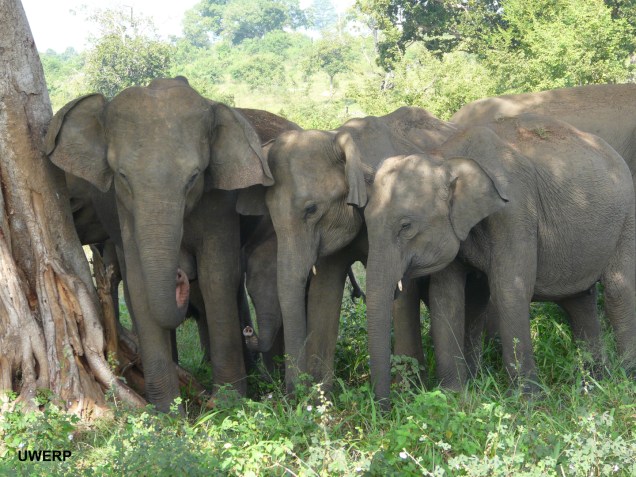
An elephant family rests under a tree in the hot midday heat. Situations like this were perfect for the playback experiments.

by SdS

In October 2007 Lucy King and colleagues first made a splash by reporting that African elephants seemed to be rather put off by bees.  I was still in Sri Lanka during my big “data collection year” as a graduate student, trying to figure out the social relationships among Asian elephants and recording vocalizations whenever I got a chance. Lucy’s first paper was a curiosity, but then three years later she followed it up with the even more intriguing finding that African elephants even produce alarm calls specific to bees. This got the attention of my advisor at Penn, Dorothy Cheney, who having expended considerable time thinking about such things as monkey alarm calls, dropped me a one-liner: “Have you seen this?” Continue reading

Evolving A More Egalitarian Elephant

coverphoto

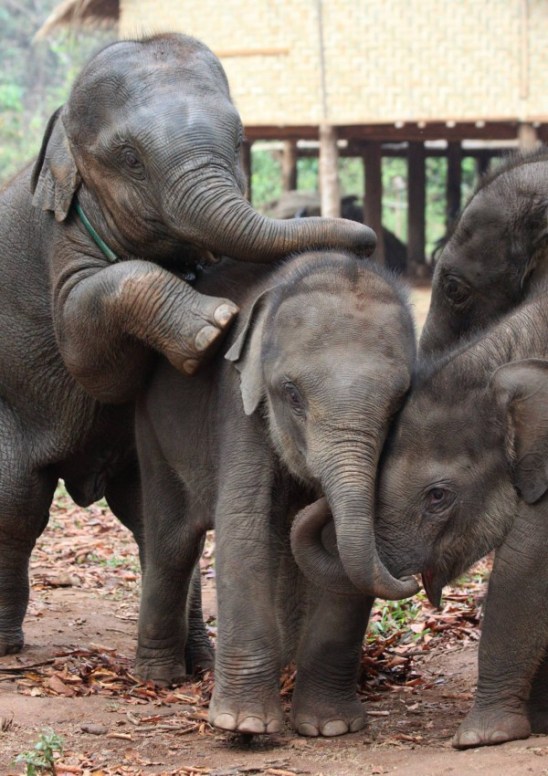
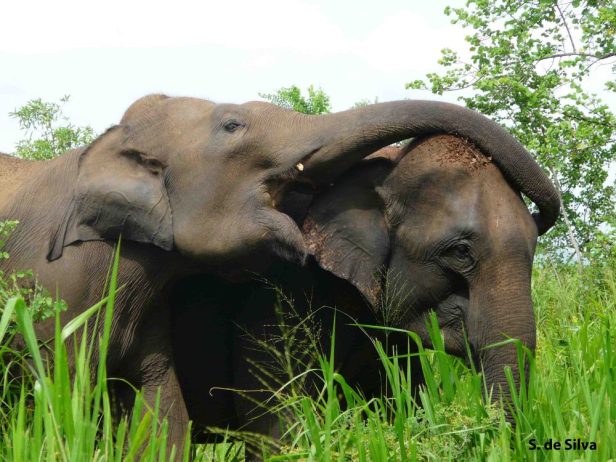
A young female named Right Hole puts her trunk over the head and back of another female of similar age with the ID [458]. The two are from different social groups, though they know each other.

Elephants are commonly thought to live in matriarchal societies which rely on the strong leadership and wisdom of elders, with strong age-based dominance hierarchies. Our new study in the journal Behavioral Ecology overturns this view, finding that in fact Asian elephants, unlike African savannah elephants (Loxodonta africana), do not exhibit clear dominance hierarchies or matriarchal “leadership” [1]. Continue reading

How early life may influence the way elephants age

Guest post by Hannah Mumby, Myanmar Elephant Project / University of Sheffield

Elephant babies in myanmar

Elephant calves at a logging camp in Myanmar. Image courtesy of Hannah Mumby.

There are a great many reasons to study elephants; they’re endangered, highly social, quite frankly huge and hold a unique and central place in many cultures. They can also be very strong, sometimes dangerous and slow to do what you want. But that’s not enough to stop me from working on them! One of my interests is actually their life cycles. In the past I’ve studied humans and non-human primates and the fact that elephants evolved long lives, almost on a par with our own, but on a separate evolutionary trajectory was fascinating to me. Elephants also usually only have one calf at a time and each calf is dependent on its mother for many years. These characteristics allow us to test a lot of ideas underpinning theories of life history and ageing, including ones that have been primarily designed with humans in mind.

So why is this interesting? Continue reading

Bring back the dead or save the living?

Trunks & Leaves's avatarThoughts For Breakfast

No, I’m not talking about zombies.

This post considers two stories in the news last week.  The first, is a new study in Science Advances by Ripple et al. finally spotlighting what we’ve known for a while: herbivores around the world are collapsing, particularly the large charismatic ones. This is bad news not just because they’re iconic species that people love to love, but because they are major components of ecosystems and their disappearance would have widespread cascading effects.

Columbian Mammoth in the George C. Page museum, Los Angeles

The second is an interview on NPR with Dr. Beth Shapiro at UC Santa Cruz on her new book How to Clone a Mammoth: The Science of De-Extinction.  It leads with the question “If science could clone a mammoth, could it save an elephant?”

View original post 808 more words

Musth, not tusks, confers advantage to duelling males

Tuskers fighting.

Two tusked bulls fighting. Photo by Karpagam Chelliah.

Bull Asian elephants come in two forms: tusk, and tuskless (this is termed dimorphism).  It’s long been thought that tusks must confer an advantage in competitions between males for dominance and mating rights.  However a recent study by Karpagam Chelliah and Raman Sukumar of elephants at Kaziranga National Park, India, puts a wrinkle on this common story. Continue reading

How will Asian elephants react to the sound of bees?

Guest post by Dr. Lucy King – Elephants & Bees Project, Save The Elephants

Apis Cerana, Photo by K. Raveendran

Apis Cerana, Photo by K. Raveendran

I’ve just returned home to Kenya after a fascinating month working with Dr Shermin de Silva and her team at the Uda Walawe Elephant Research Project in Sri Lanka. There have been several productive links between Dr de Silva’s project and ours at Save the Elephants over the years and key to the collaboration has been the ability to compare elephant population ecology between Kenyan and Sri Lankan elephants. However, I went to work in Uda Walawe National Park for an entirely different reason – bees! Continue reading

Dwarf elephant battles musth male!

16 June 2014 – S. de Silva

Battle1A clear sunny day, Lucy and Mickey are off in the park with Sameera while Kumara and I stay behind to catch up on office work. It’s mid-morning when Sameera calls to tell us Walawe Kota is back!  Walawe Kota is the nickname we’ve given the dwarf elephant of Uda Walawe.  This would be at least the third year now. What’s more, he’s in musth and reportedly fighting another male.  At first, the news is a bit confusing – there’s mention of a possible injury.
I’ve never seen him in the flesh though Kumara and Sameera have. I’ve only seen pictures and video clips, so I’m eager to try our luck. The park office reports he’s been spotted not far from the entrance, so we hop in our Jeep and dash off in hopes he’s still out in the open. Continue reading

Who misses the mega-fauna, if they disappear?

Guest post & graphics by Nitin Sekar, Princeton University

DSC03329

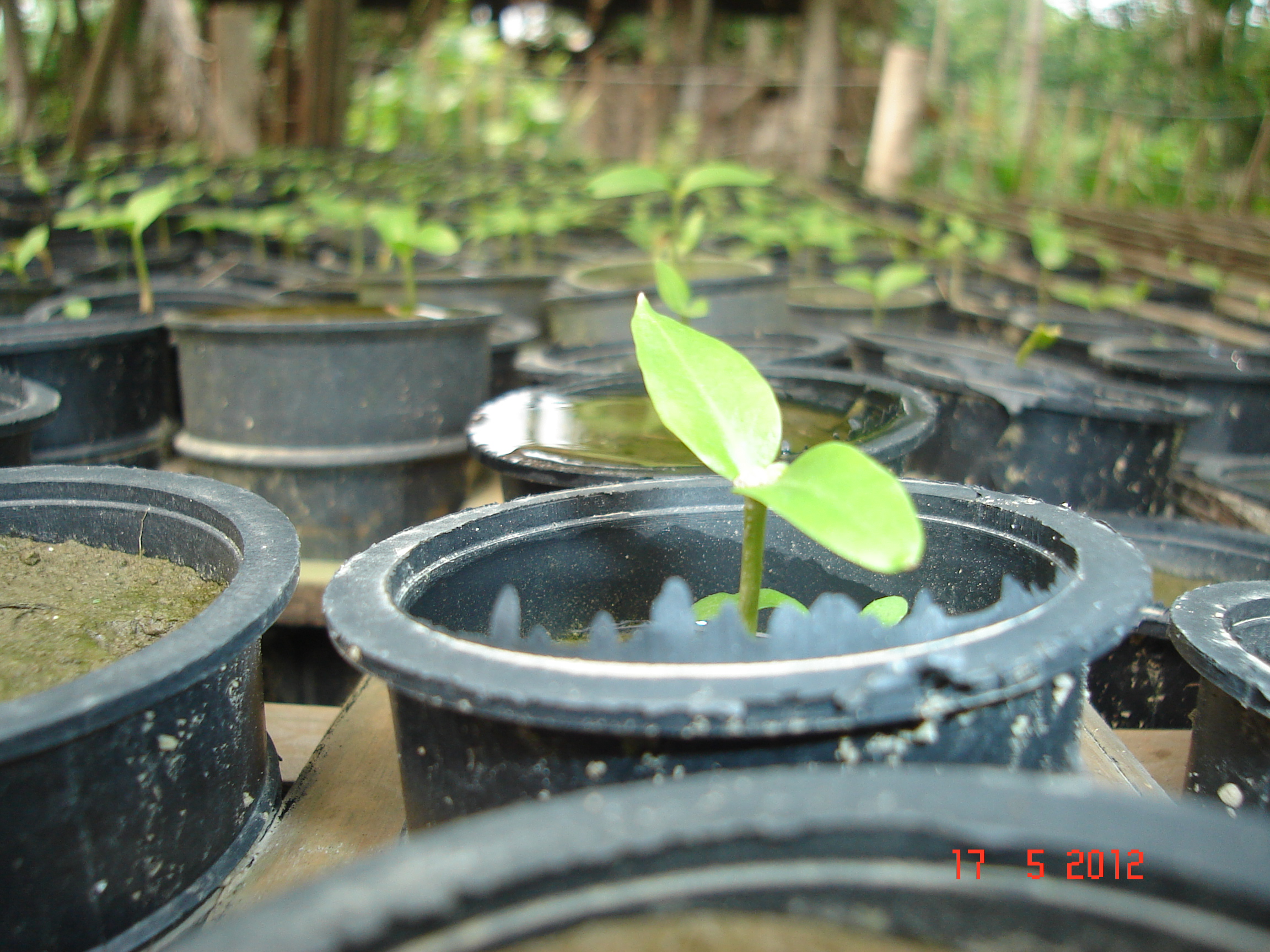
A seedling germinates from elephant dung.

All around the planet, the world’s largest animal species are becoming very rare. Whether we speak of giant tortoises, large wild cows like gaur, rhinoceroses, hippos, tigers, or whales, local extinction or extreme reductions in range size and population are the norm for species that are too big or too slow-reproducing to withstand human conflict or the human hunter. Most people would probably agree that it is a shame to lose these species. But what about functionally? Are the largest animals critical to any ecological processes? When there are declines in honey bee populations, human agriculture suffers; if nitrogen fixing plants are absent from a forest, other plant species may be affected. When the largest animal species go missing, do any other species miss them? Aside from a few cases, we don’t know! This is an active area of research.

We decided to explore the role of Asia’s largest land mammal—the Asian elephant (Elephas maximus)—in seed dispersal, which helps maintain the diversity of tropical forests. Continue reading

How does empathy help elephants?

By SdS

P1490826 P1490832

P1490840

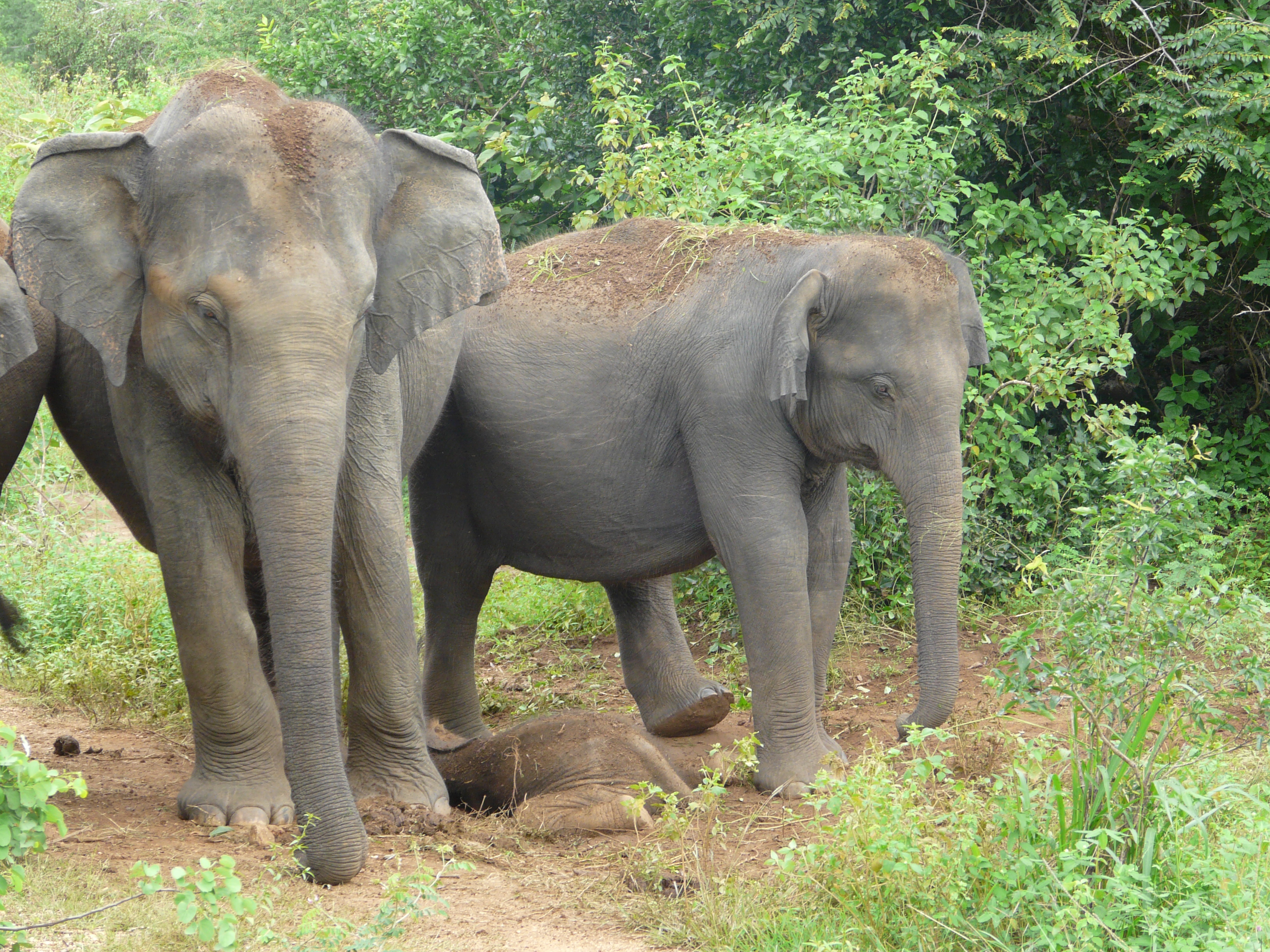
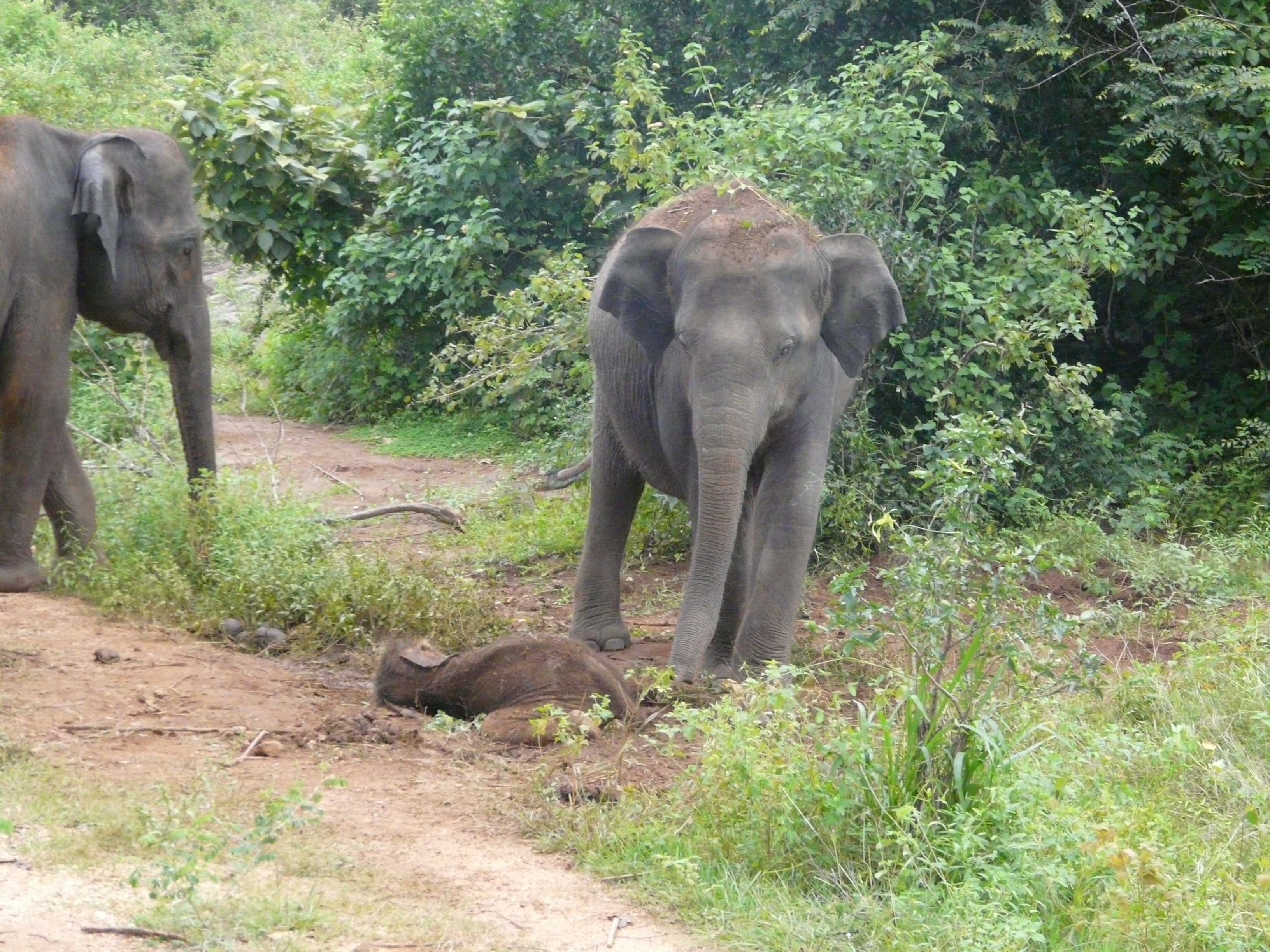
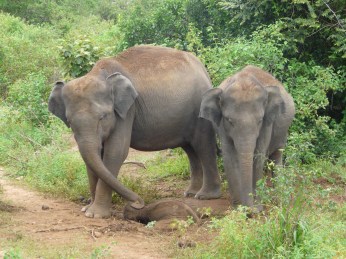
A small family of elephants in Uda Walawe wanders upon a dead calf which does not belong to them. Yet they show great interest, touching and hovering over the body for hours, refusing to let any observers near until they finally decide to move off. Photos: UWERP

In the past week a paper on reassurance behavior in elephants by Plotnik et al. in PeerJ has been generating quite a bit of buzz. The study, which you can learn more about from the researchers themselves here, collected a series of observations on a group of captive elephants in Thailand documenting how they reacted when one of their companions was distressed.  It showed that when some individuals were disturbed in some way and expressed their distress, other individuals approached them and interacted in ways (such as touching, vocalizing) that suggested that they might be trying to comfort or console their companion.  Such behavior would indicate that elephants have the capacity for empathy, along with a handful of other species.

The title of this post is meant to work on at least two levels. First, we might wonder at a biological level – what is the function of the curious  behavior elephants sometimes show toward others in distress? Why might it have evolved? Whom does it benefit? Second, we might wonder at a practical level – should the capacities of elephants endow them with additional conservation value? Should it matter on the ground? So today, the first ever World Wildlife Day, I’d like to examine these two sets of questions, which are very distinct. Continue reading