Elephants and electricity

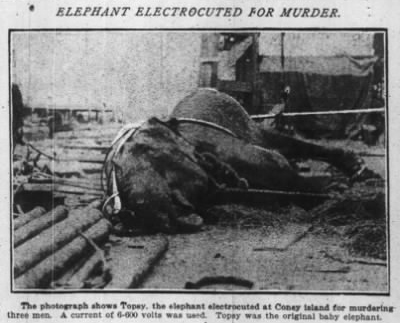
Topsy the circus elephant, electrocuted in 1903 by Thomas Edison's technicians in carrying out her death sentence while demonstrating the dangers of AC current.

Topsy the circus elephant, electrocuted in 1903 by Thomas Edison’s technicians in carrying out her death sentence while demonstrating the dangers of AC current. Photo: Chicago Tribune

By Ilja Van Braeckel

New York, anno 1903. The city stirs as dawn breaks. Woken up by the distant rumble in the neighboring tenement, you might join the breakfast table. You might appreciate your morning cup of chicory root coffee and nibble on some hard-earned buttered toast. You might scratch your head and raise an eyebrow or two as you open the newspaper and read how none other than Thomas Edison electrocuted Topsy, the 28 year female Asian elephant. You might learn how the murderous ‘beast died without a trumpet or a groan’, in Edison’s slanderous attempt to discredit his rival’s discovery of alternating current, per demonstration of its potential hazard.

Uda Walawe today, some 14 000 km and 110 years away. Neither Topsy nor Edison outwitted the tusk of time and all that remains of the unfortunate elephalectric turn of events is the original video footage and the alternating current that proved innovative. In fact, electricity is now commonly used to separate humans from other animals and this is no different in Uda Walawe, where the national park is delimited by an electric fence line. In reality, however, frequent power cuts make its efficiency questionable to say the least and the elephants, keen creatures that they are, seem to have learned to jostle over the fence poles. Continue reading
Morning walk

By Ilja Van Braeckel

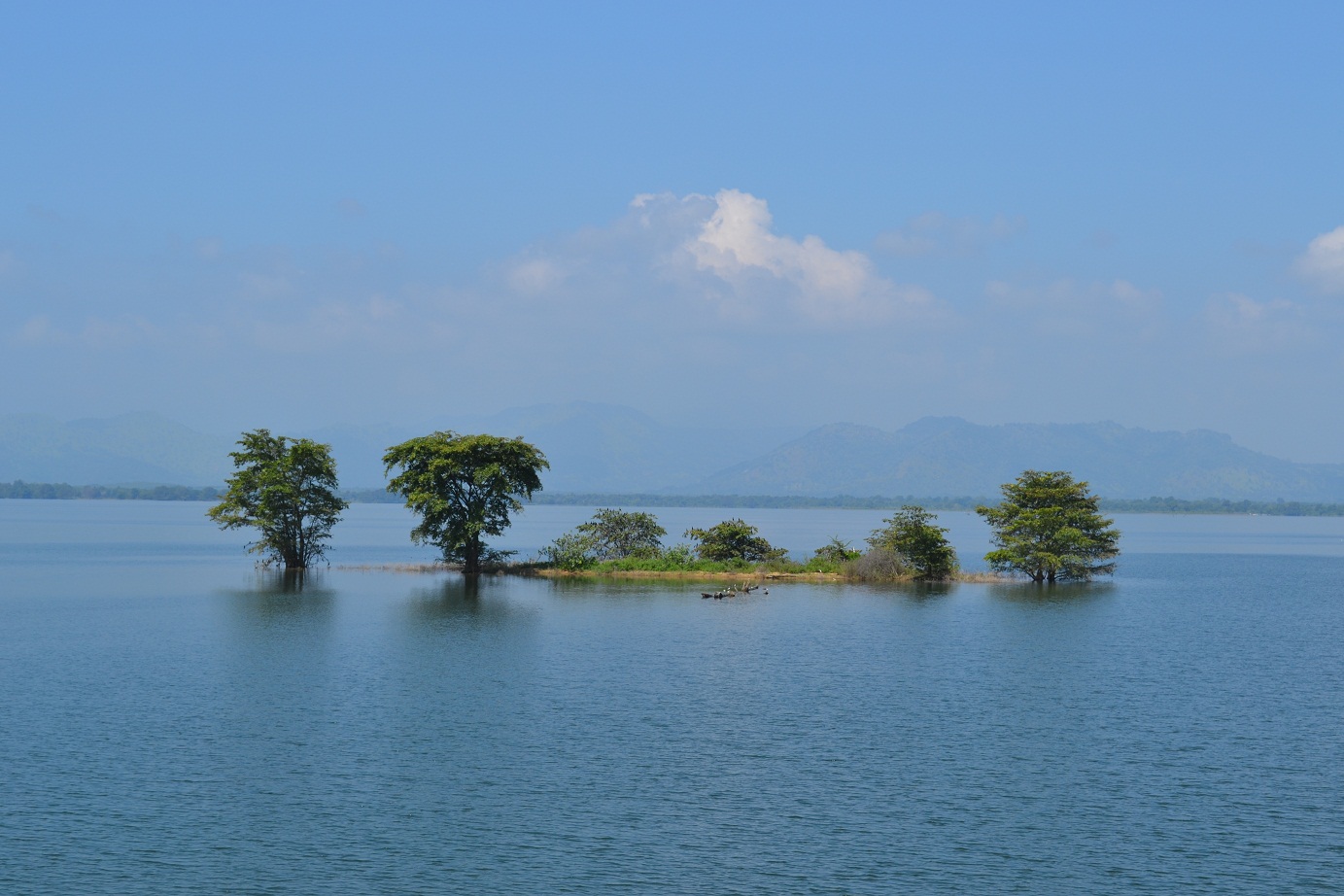
The island that is not an island.

The island that is not an island.

On a beautiful Sunday morning, I left for the Uda Walawe reservoir. I had traveled this way before, and I knew what to expect. This man-made reservoir is located within the national park’s boundaries, and is separated from the road by the electric fence. Being approximately 3400ha in size, it is a significant source of hydroelectricity, and I had high hopes for spotting wildlife. A good hour and my morning King coconut later, the first specks of reflected sunlight started to appear on the horizon between the trees. The sky was particularly clear and there wasn’t a sigh of wind. I quickened my steps, and, non-compliant to popular advice, kept walking towards the light in a steady pace. A few specks made way for hundreds, and then thousands, and with every step I gained, the view became more spectacular, as if the reservoir invited you kindly to acknowledge its splendor. Continue reading

The Twilight Visit of Ghost

*Note from SdS: the following is an account based on Sameera’s experience. I’ve come to think of this mysterious tusker as ‘Ghost’ because we so rarely see him and know so little about him. The name has stuck in my head, so that’s going to be his nickname from now on.

– 27 November 2011 –

It was about 2 o’clock in the morning when I woke up to the sound of something brushing past the pipes outside. It was near the water tank. As I listened harder, I began to make out a distinctive sound – an elephant eating.

Walking over to the window, I could just make out the dark bulk of a big male. I was by myself in the field station, sleepy and tired, but very quickly I became alert. Our housekeeper, who usually sleeps on a bed on the porch, had gone home for the weekend. I was glad about this because I thought he surely would have turned on the lights and scared off our visitor.

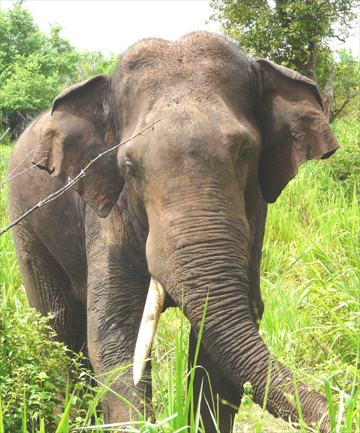
Tusker “209” which seems to have been translocated into Uda Walawe National Park in early 2010.

For months we had seen and heard evidence of elephants breaking through the electric fence, but despite numerous attempts they were impossible to find and track down once they got into the sugar cane across the road. There were at least four elephants responsible, people thought. At least one of them was a one-tusked male. We suspected it was an animal that had been translocated into the park last year, but had not been able to verify this. This was an important chance to catch one of the culprits in the act. Continue reading

The Elephant’s Chirp

Given the previous post about what shall now infamously be known as the incident of 2011, I thought it would be nice to lighten things up by sharing our other experiences with males in musth. Moreover, this is about one of those moments every scientist lives for: discovery.

First of all what is ‘musth’?  Musth is a condition that male elephants undergo after their teens which is similar to rutting in sheep and deer, in which males spend most of their time trying to find reproductive females and battling other males for dominance.  Hormonally, it means they are pumped full of testosterone.  Typically a male has to be in very good body condition to enter musth, and the older he is the longer it can last – several months in some cases – and during that time he eats very little.  You know a male is in musth when he shows reddish wet patches on the sides of his temples (just behind the eyes), and dribbles urine.  Oh yes – and he also smells to high heaven (some of us happen to think it smells rather good, musky sweet and thick…but then again, some of us also like the smell of Durian).
Continue reading