Leakey mounts

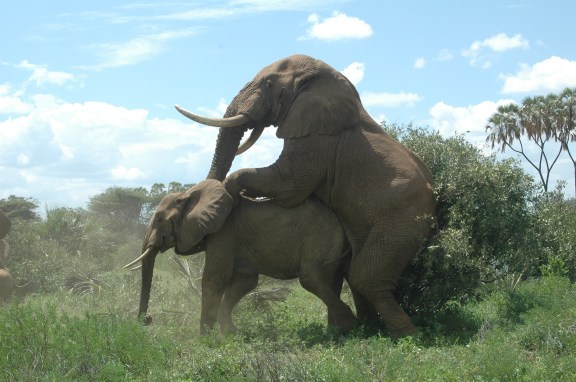
Leakey, one of the largest old bulls to appear in the Samburu population, mates with Nicky of The Artists.

Male elephants continue to grow throughout their lives, getting bulkier and broader. Older males enjoy a greater competitive advantage and higher reproductive success. Many have a characteristic time of year when they are seeking mates, and as they get older they increasingly advertise their state with strong-smelling chemical signals in their urine and temporal secretions in a condition termed ‘musth’. Younger bulls, who don’t appear to be signaling consistently or at all, may also try their chances when a receptive female is available.  But they are prone to being chased off by the bigger, more dominant males.
Continue reading

Mating pandemonium

First day

Guest post by Michael Pardo, Cornell University

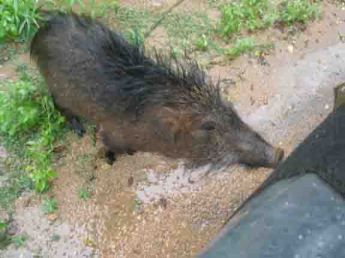
Wild boar

Curious boar.

December 18, 2012

A breathtaking expanse of bushes peppered with trees.   That is my first impression of Uda Walawe National Park as we pass through the entrance gate in the early hours of the morning.  The shrubs grow densely packed on either side of the ochre-colored road, like a vertically challenged forest.  They are interspersed with teak saplings, a reminder of the days when this park was a timber plantation.  Towering banyan trees soar above the surrounding vegetation, peacocks perched in their uppermost branches.  In the distance, I can see the blue mountains and waterfalls of Nuwara Eliya, and above them, a steely sky striated with rain-laden clouds.  A grey mongoose crosses the road ahead of us, stopping briefly to stare at our jeep before disappearing into the wall of greenery.  Flocks of Common Mynas and Spotted Doves spring into the air as we rumble past.

Continue reading

A wall of elephants

December 9 2012, Samburu

A rainstorm fills the Ewaso Nyiro river. True to its name, the water is a rich orange-brown and as thick as Thai iced tea. It gurgles alongside the camp, snaking past wide sandy banks with steep sides like miniature beaches bordered by miniature cliffs.

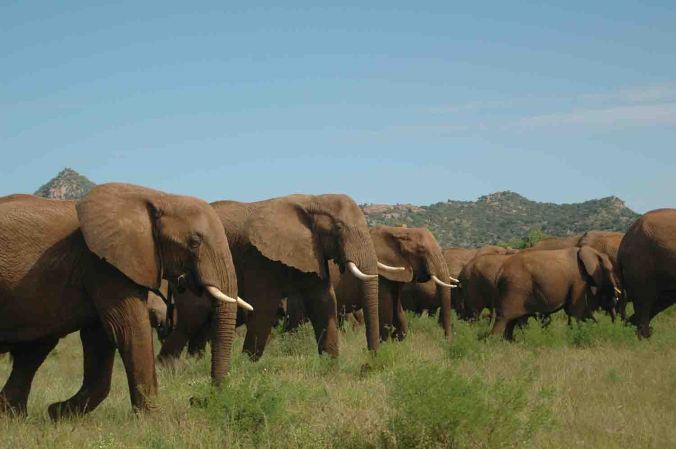
To see the elephants, the river and its shaded woodland border is the place to be in the dry season.  But these days, with water puddling up everywhere elephants are ranging further from it. The other day we came upon a vast herd on the bank. Gathered in its ranks were multiple families, but on the following days hardly anyone came down again except to cross to the other side.

A vast herd marches in unison.

A vast herd marches in unison.

Continue reading

Savannah elephants in Samburu

27 November 2011

Samburu, Kenya

A multitude of birds are chirping outside in the trees overlooking the river that snakes through this duo of national reserves in Kenya.  Samburu and Buffalo Springs sit almost squarely in the middle of Kenya. The landscape consists of low thorn bush, acacia trees, and a few grasses along the water’s edge.  Strange multi-branched “doum palms” line the riverbanks, looking a bit like coconut trees trying to evolve into something else in a hurry (see my friend Andreas Gros’ beautiful photo here). Faint blue outlines of hills rise in the distance.

Peek-a-boo!

Continue reading

Elephants, engineers of the forest

October 2012

Who dunnit?  Which animals are responsible for planting seeds throughout the forest?

Who dunnit? Which animals are responsible for planting seeds throughout the forest?

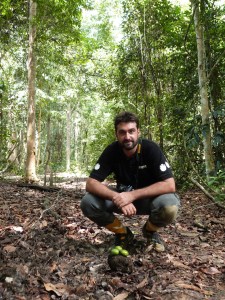
My next stop is the University of Nottingham Malaysia campus, where I meet my colleague and friend Ahimsa Campos-Arceiz.  A Spanish transplant in Malaysia, Ahimsa has spent the past year with great gusto setting up MEME (Management and Ecology of Malaysian Elephants).  I recognize the energy, it’s the same enthusiasm shared by Benoit and George, my current supervisor. What all these people have in common is a firm belief in what they do, a single-minded determination that appears never to falter. Truly something to behold. Continue reading

Borneo by boat

October 2012

Sukau, Sabah province – Borneo, Malaysia

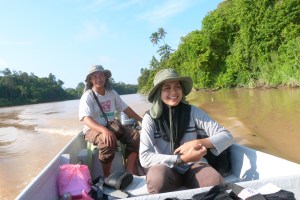
Farina_boatSukau is a sleepy little town on the eastern side of Sabah, tucked along the Kinabatangan river.  What brought me here is an unlikely acquaintance made via Facebook.  A few years ago I got a message from one Nurzhafarina Othman saying she was studying the social organization of Bornean elephants, and she had come across my thesis – could I answer some questions for her? Of course, I said, and so began a little exchange of emails about studying elephants.  I grew curious to meet Farina, who seems an unlikely candidate to be traipsing around the forest given her otherwise conservative Malay Muslim background.  Since I too come from the Sri Lankan Malay community, it seemed we had a lot in common.  Little did I know. Continue reading

2 upcoming talks by Shermin de Silva

“Elephant Social Dynamics and Conservation”
National Centre for Biological Sciences (NCBS), Bangalore
Friday Nov. 16th, 4pm

“The Spatial and Temporal Dynamics of Social Affiliations Among Asian Elephants”
Jawaharlal Nehru Centre for Advanced Scientific Research (JNCASR), Jakkur
Evolutionary and Organismal Biology Unit
Saturday Nov. 17th, 11:30am

Asian elephant imitates Korean speech

Koshik is a 12-year-old male Asian elephant housed at the Everland Zoo in South Korea.  For some years he had been a local star that was the subject of some internet fame due to his uncanny ability to produce human-like sounds.  Not only this, but they actually seemed to resemble Korean words.

In a new paper in the journal Current Biology by Angela Stoeger and colleagues, Koshik’s vocalizations were put to the test.  Could he really produce words, as trainers claimed?

The researchers recorded Koshik’s special utterances and played them back to a panel of native Korean speakers who had never heard him before. These participants did not know who was producing the sounds or what they were supposed to mean. They were then asked to write down the words they heard.  They found that Koshik’s call resembled five Korean words: ‘‘annyong’’ (hello), ‘‘anja’’ (sit down), ‘‘aniya’’ (no), ‘‘nuo’’ (lie down), and ‘‘choah’’ (good).  He appeared to be very good at reproducing the vowels in each of the words, but the consonants were more problematic.  “Choah” for instance was interpreted sometimes as “boah” (look) and “moa” (collect) by the human listeners.

Continue reading

Rainmaker

Guest post by Austin Diamond —

03 October 2012

This is Amber.  She is a grandmother.

She has three daughters.  They are all comfortably married (more or less), prefer grass to grapes, and have suffered their share of life’s sorrows and joys.

Undeniably the pride and joy of the household, at this moment, is Little One.

Little One is celebrating her first month on this planet.  Her mother and aunts are wildly protective.  As the Land Rover draws too close, they flank Little One on both sides, so that she is saved from our glances.  Still, her curiosity cannot be suppressed, as she steals a glance at us from under her mother’s belly. Continue reading

Talk on human-elephant conflict hosted by Wildlife and Nature Protection Society

***Please note change of title***

Who: Shermin de Silva

What: ELEPHANT  BEHAVIOR AND CONSERVATION: Lessons From Uda Walawe

When: July 12 2011, 6:00 pm

Where: Institute of Engineers, Colombo 07