Elephant Gardens

Guest post by Jessie Panazzolo
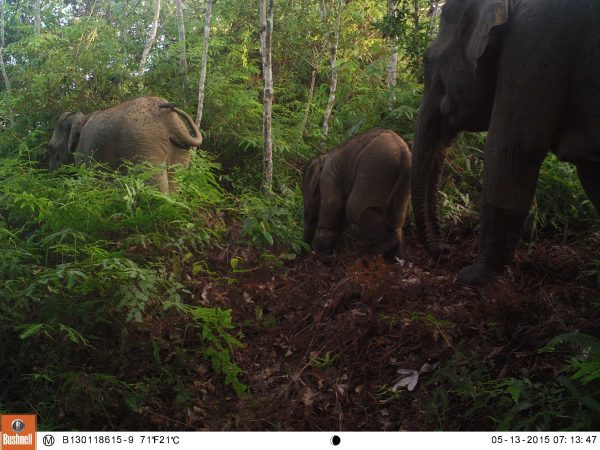
A camera trap photo shows Sumatran elephants trekking through lush regenerating forest.

I had always been told the same thing over and over again from my schooling, the scientific papers I read, and people I met growing up. This was that once primary rainforest was gone and removed from the Earth, it could not grow again. I was told that the forest needed a constant cycling of nutrients to flourish. That without the trees blanketing the ground in leaf litter the soil would be devoid of any nutrients needed to create such rich life again.

I had also been told that important forest dwellers such as the Sumatran Orangutan would only find a home in thick established forests. I had read in many different papers that Sumatran Orangutans, unlike their Bornean cousins, never spent any time walking on the forest floor in fear of the predatory Sumatran Tiger.

Considering all this, you could imagine my surprise and awe when I found myself in the middle of a brand new Sumatran rainforest, barely five years old, seeing orangutans walk the ground in front of my very eyes. It was then that I knew that anything was possible. Continue reading
Facing The Threat Together

By Mickey Pardo, Cornell University & Open University of Sri Lanka

Down the Old Mau Ara Road we drove, my head swiveling left and right as I scanned for elephants on the grassy strips to either side.  Then we rounded a bend, and Lucy slowed to a stop in front of the herd standing thirty meters away.  It was a rather large group:  [472], [873], [075], and [151], along with a number of sub-adults and juveniles.  [151] and a sub-adult female approached slowly to within a few meters of our jeep.

Mickey_elephants1

RAAAAAAAHHHHHHH!  With no warning, they bellowed in our faces in deafening unison! Continue reading

A new arrival

By Michael Pardo, Cornell University

Monday, February 10:

IMG_0141

I gazed out on Uda Walawe National Park for the first time in over a year as our jeep trundled through the entrance gate.  I welcomed the cool morning air that I knew would swiftly turn hot as the sun climbed higher in the sky.  Dark clouds loomed threateningly overhead, but they were all bluff.  Uda Walawe is experiencing something of a drought this year—while we were driving to the park I noticed that the roaring river I remembered from last December had been replaced by a wide strip of boulders and trees.

Drought does have its advantages though.  The ponds and reservoirs in the park had receded, baring flat, open areas that stood out in stark contrast to the dense shrubs and trees blanketing most of the habitat.  I knew that if we were lucky enough to encounter elephants at any of these waterholes, I would have a clear line of sight for behavioral observations. Continue reading

How to study social networks in elephants

Another nice summary of our work by Pleuni Pennings. Don’t forget to join us on December 21st at the Randall Museum if you are in San Francisco!

pleunipennings's avatarBeing A Better Scientist

Elephants are smart and social, and sometimes they seem very much like humans, for example when they mourn their dead. Long term research by Shermin de Silva and colleagues (BMC Ecology, 2011) showed that their friendships are also very much like ours.

Who is she hanging out with?

Shermin and her colleagues observed 286 female elephants over 20 months in Uda Walawe National Park in Sri Lanka. Every time the field crew saw one of the elephants, they noted who she was with. The data could later be analyzed using tools from network analysis.

How to recognize 286 elephants?

But wait a second, 286 elephants … that’s a lot of elephants to remember. You may wonder how recognizing so many individual elephants is even possible for Shermin and her crew. Well, the answer is twofold. First of all, all elephants have different ears. Second, Shermin and her colleagues…

View original post 498 more words

An Evening With Elephants

pleunipennings's avatarBeing A Better Scientist

I am trying out something new this month: I am hosting a fundraising event!

The event will take place on December 21st in San Francisco in the Randall Museum. We’ll show a BBC movie about elephants in Sri Lanka (trailer) and my friend Shermin de Silva will give a talk about her work with these same elephants.

Shermin de Silva

Shermin is an inspiring woman. She runs a field station in Sri Lanka, works in the United States (she is a postdoc in Fort Collins) and manages to raise enough money to keep her research going. This, as you can imagine, is not easy!

Her research is interesting, because she is one of few people who follows individual elephants in a wild Asian elephant population over time. Because she and her field crew know the individual elephants, they can see when elephant friendships form and break. It…

View original post 239 more words

A Trunkful of Puzzles

By Lizzie Webber, University of Stirling 

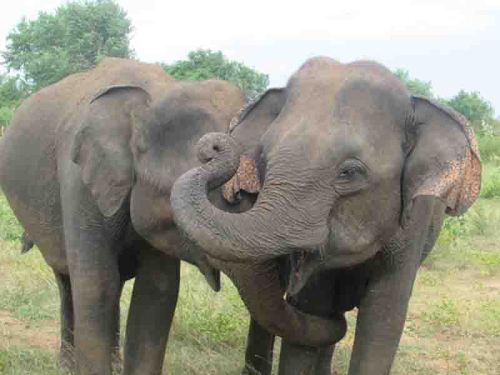
2013: Sub-adults trunk wrestling with [t458] and [c458_12] nearby

2013: Sub-adults trunk wrestling with [t458] and [c458_12] nearby.

After studying the elephants in Uda Walawe National Park (UWNP) for three field seasons, many of their IDs and personalities are now firmly rooted in my memory. This has allowed me to continue unravelling some identity puzzles in my study while bridging together my field seasons from 2011, 2012 and 2013.

In 2013, [c458_12] (the calf of [458], born in 2012) was one of the most playful characters of the season. A male calf, he was often off with the older crew of juveniles and sub-adults (possibly cousins) who hung out with his family unit. Continue reading

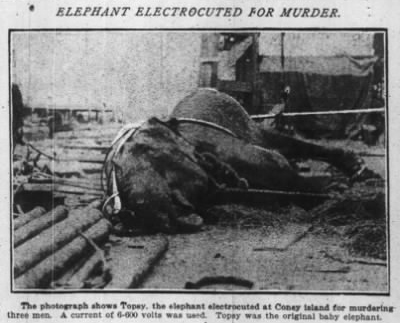
Elephants and electricity

Topsy the circus elephant, electrocuted in 1903 by Thomas Edison's technicians in carrying out her death sentence while demonstrating the dangers of AC current.

Topsy the circus elephant, electrocuted in 1903 by Thomas Edison’s technicians in carrying out her death sentence while demonstrating the dangers of AC current. Photo: Chicago Tribune

By Ilja Van Braeckel

New York, anno 1903. The city stirs as dawn breaks. Woken up by the distant rumble in the neighboring tenement, you might join the breakfast table. You might appreciate your morning cup of chicory root coffee and nibble on some hard-earned buttered toast. You might scratch your head and raise an eyebrow or two as you open the newspaper and read how none other than Thomas Edison electrocuted Topsy, the 28 year female Asian elephant. You might learn how the murderous ‘beast died without a trumpet or a groan’, in Edison’s slanderous attempt to discredit his rival’s discovery of alternating current, per demonstration of its potential hazard.

Uda Walawe today, some 14 000 km and 110 years away. Neither Topsy nor Edison outwitted the tusk of time and all that remains of the unfortunate elephalectric turn of events is the original video footage and the alternating current that proved innovative. In fact, electricity is now commonly used to separate humans from other animals and this is no different in Uda Walawe, where the national park is delimited by an electric fence line. In reality, however, frequent power cuts make its efficiency questionable to say the least and the elephants, keen creatures that they are, seem to have learned to jostle over the fence poles. Continue reading

Morning walk

By Ilja Van Braeckel

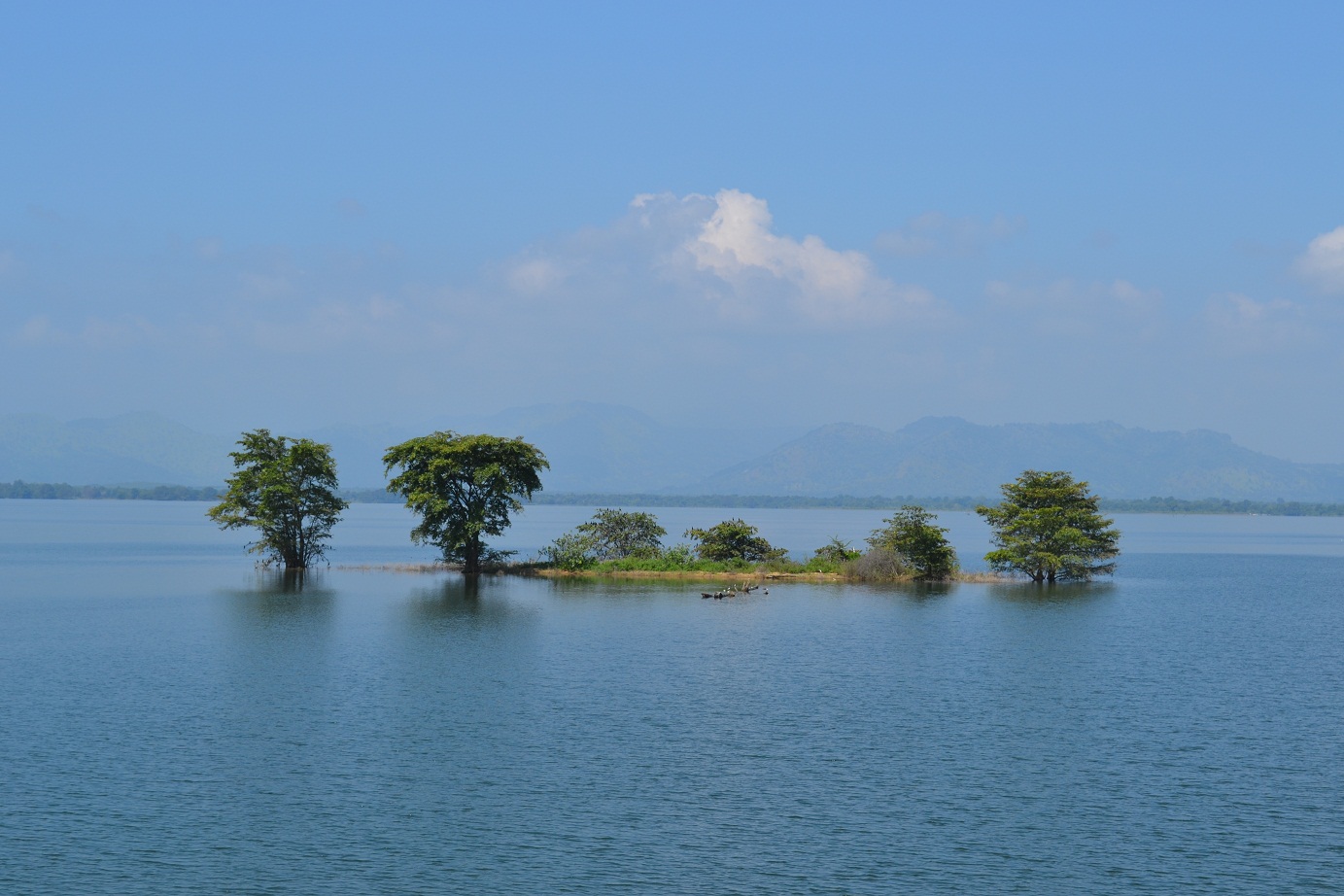
The island that is not an island.

The island that is not an island.

On a beautiful Sunday morning, I left for the Uda Walawe reservoir. I had traveled this way before, and I knew what to expect. This man-made reservoir is located within the national park’s boundaries, and is separated from the road by the electric fence. Being approximately 3400ha in size, it is a significant source of hydroelectricity, and I had high hopes for spotting wildlife. A good hour and my morning King coconut later, the first specks of reflected sunlight started to appear on the horizon between the trees. The sky was particularly clear and there wasn’t a sigh of wind. I quickened my steps, and, non-compliant to popular advice, kept walking towards the light in a steady pace. A few specks made way for hundreds, and then thousands, and with every step I gained, the view became more spectacular, as if the reservoir invited you kindly to acknowledge its splendor. Continue reading