Thinking like elephants

By: Lisa Barrett, Research Assistant – Think Elephants International, Inc.
Photos: Elise Gilchrist (c) 2014, Think Elephants International, Inc. www.thinkelephants.org

Plotnik3Think Science. Think Education. Think Elephants. That’s our motto at Think Elephants International (TEI), a nonprofit based in northern Thailand.  Founded by Dr. Joshua Plotnik in 2010, TEI’s aim is to conserve wild Asian elephants in Thailand by integrating elephant intelligence research with conservation education programming. We “think elephants” both because we think of elephants when we consider ways to help improve their conservation status, and we also think like elephants in designing our research paradigms. We use scientific research to understand how elephants “see” their world and how we can most effectively save their world. Dr. Plotnik has shown that elephants are both able to pass the mirror self-recognition task (Plotnik et al. 2006) and that they can cooperate together to complete a novel problem (Plotnik et al. 2011). In addition to demonstrating the amazing cognitive abilities of this species, we are also passionate about research that can directly impact conservation techniques to mitigate human-elephant conflict. Continue reading

The “Elephant Grammar” Project at Uda Walawe National Park

By Mickey Pardo, Cornell University

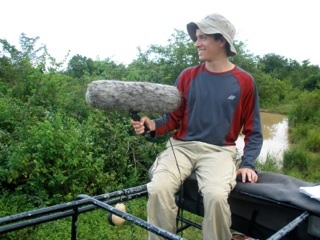
Do Asian elephants have grammar?  I aim to find out why Asian elephants combine different calls into sequences by recording vocalizations, playing them back to the elephants, and observing their responses.  From January to July 2014 I will collect video and audio recordings of the elephants in Uda Walawe National Park, Sri Lanka, and I will also conduct some preliminary playback experiments to determine the meanings of different calls.  However, this work is extremely expensive, and because my research is not covered by my advisor’s grants, I am responsible for funding 100% of my project on my own.  To help raise the money I need, I have started a crowd funding campaign on the platform Microryza.  The idea is to raise a significant amount of money via many small donations.  The funds that I raise through this campaign will be used to help pay for 4×4 vehicles that I need to transport myself, my field assistants, and my equipment inside the park.  If you donate to my campaign, I will send you periodic updates from the field, including photos and videos of the elephants I study.  Here is a link to my project:  https://www.microryza.com/projects/do-asian-elephant-calls-have-grammar-like-elements

You can find previous posts from the field at the links below:

An Evening With Elephants

pleunipennings's avatarBeing A Better Scientist

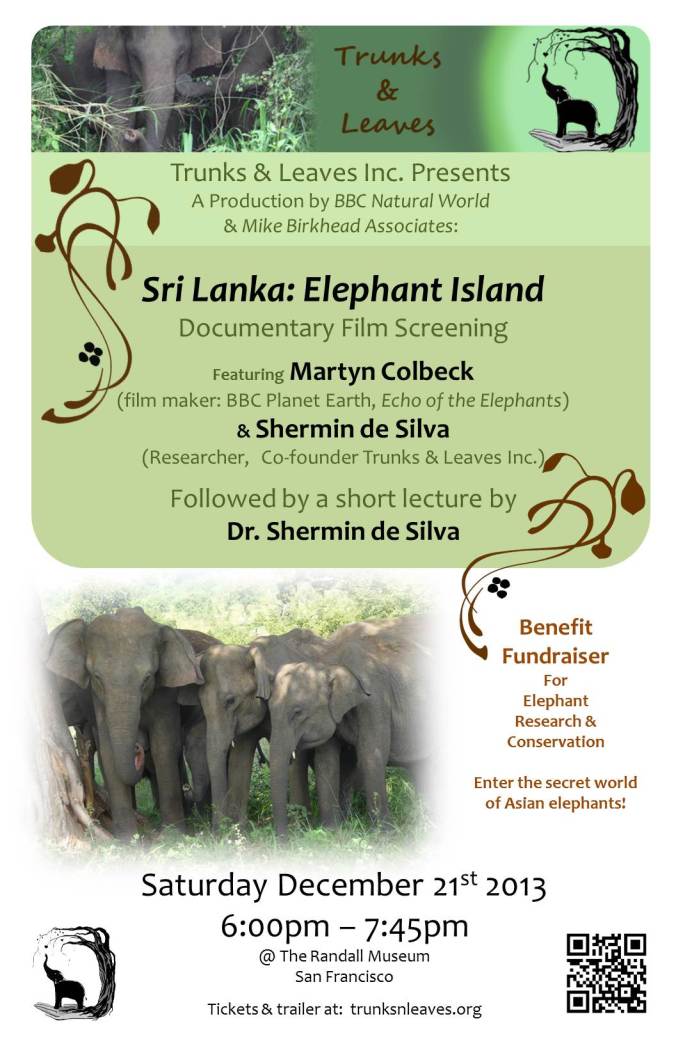
I am trying out something new this month: I am hosting a fundraising event!

The event will take place on December 21st in San Francisco in the Randall Museum. We’ll show a BBC movie about elephants in Sri Lanka (trailer) and my friend Shermin de Silva will give a talk about her work with these same elephants.

Shermin de Silva

Shermin is an inspiring woman. She runs a field station in Sri Lanka, works in the United States (she is a postdoc in Fort Collins) and manages to raise enough money to keep her research going. This, as you can imagine, is not easy!

Her research is interesting, because she is one of few people who follows individual elephants in a wild Asian elephant population over time. Because she and her field crew know the individual elephants, they can see when elephant friendships form and break. It…

View original post 239 more words

Linnaeus’ Asian elephant – or not?

Very recently, an article from the Zoological Journal of the Linnaean Society was released regarding the mix-up of Linnaeus’ identification of the species Elephas maximus, or the Asian elephant. In 1764 Linnaeus documented a preserved elephant fetus (which is held today at the Swedish Museum of Natural History in Stockholm) as E. maximus in his studies. He believed it to have originated in Ceylon, now Sri Lanka, and this was long established as the so-called ‘type’ specimen of the species. Since Linnaeus never distinguished between Asian and African elephants, the true identity of the fetus has been in question and many suspected it to resemble the African species. Cappellini et al. decided to put the issue to rest and conducted ancient protein and DNA sequencing analysis to determine the true identity of the elephant fetus syntype. It just so happens that the fetus is in fact of the African elephant, in the genus Loxodonta.
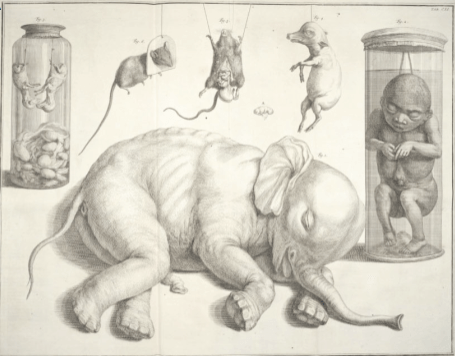
An illustration of the elephant fetus from the Swedish Museum of Natural History referred to by Linnaeus

An illustration of the elephant fetus from the Swedish Museum of Natural History referred to by Linnaeus

This created quite a quandry because a new type specimen would have to be designated for reference, and according to the taxonomists’ rules, it could not be any arbitrary individual but preferably one that Linneaus had listed in his notes. At first it appeared a tooth fragment might be next possible canditate, which seemed rather unsatisfying since it was not an intact animal.  But luckily, Linnaeus had also cited a text by John Ray in which he describes the skeleton of an elephant. Apparently this skeleton, which had belonged to a touring performing elephant, is still intact at the Natural History Museum of Florence and was also thought to have originated from Sri Lanka. After analyzing the elephant skeleton’s DNA, Cappellini et al. were able to determine that the elephant was indeed the very specimen referred to in Linnaeus’ notes. E. maximus!
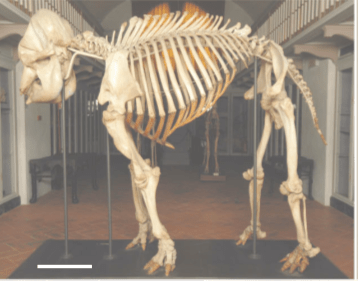
The E. maximus skeleton at the Natural History Museum of the University of Florence,

The E. maximus skeleton at the Natural History Museum of the University of Florence, the new type specimen if approved by the society.

Interested in learning more details on the Cappellini et al. article? Go here: http://www.nature.com/news/linnaeus-s-asian-elephant-was-wrong-species-1.14063

ResearchBlogging.org
Cappellini, E, A Gentry, E Palkopoulou, Y Ishida, D Cram, A Roos, M Watson,, US Johansson, B Fernholm, P Agnelli, F Barbagli, DTJ Littlewood, CD Kelstrup, JV Olsen, AM Lister, AL Roca, L Dalen, & MTP Gilbert (2013). Resolution of the type material of the Asian elephant, Elephas maximus Linnaeus, 1758 (Proboscidea, Elephantidae) Zoological Journal of the Linnaean Society, 1-10 DOI: 10.1111/zoj.12084
Parting thoughts

Guest post by Michael Pardo, Cornell University

Friday, January 11, 2013

It’s hard to believe that this is my last day in the field.  The past month that I’ve spent at Uda Walawe seems to have gone by so quickly.  Part of me is eager to return to the US, where I will finally be able to sort through all the information that I have collected here.  But I do not want to leave the park and its elephants, and I resolve to savor this final day.

A juvenile plays on a mound.

A juvenile plays on a mound.

Continue reading

On a roll

Guest post by Michael Pardo, Cornell University

Monday, January 7, 2013

We’ve been on a roll this last week.  Or maybe the elephants have.  Either way, I’ve heard far more vocalizing in the past week than in both of my first two weeks combined, and have managed to record some of it as well.  I hope for our luck to continue as we gather our equipment this morning and pile into the jeep.

Baby on the road

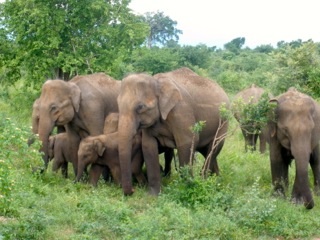
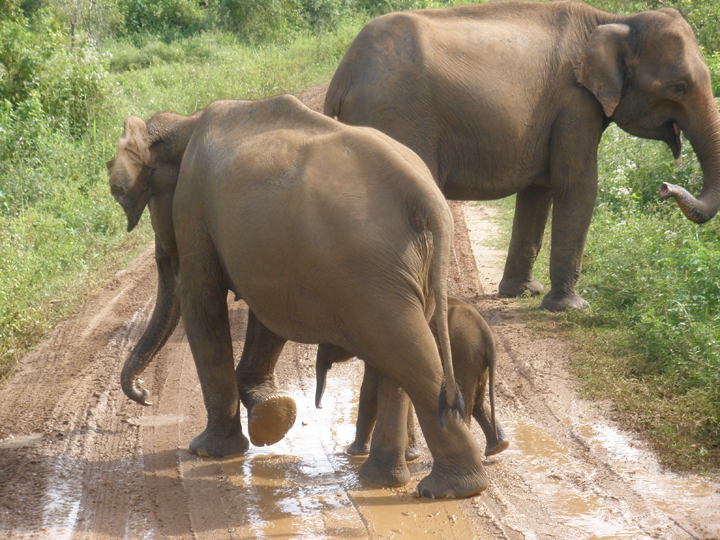
Before long we see [474]’s group, and almost immediately hear a rumble.  Unfortunately Kumara and I are still busy setting up the recording equipment, but I wait in the hopes of catching another call.  As I watch the elephants, I notice that they seem unusually “touchy-feely” today, for lack of a better word.  Continue reading

Recording elephants

Guest post by Michael Pardo, Cornell University

Monday, December 31, 2012

Batik

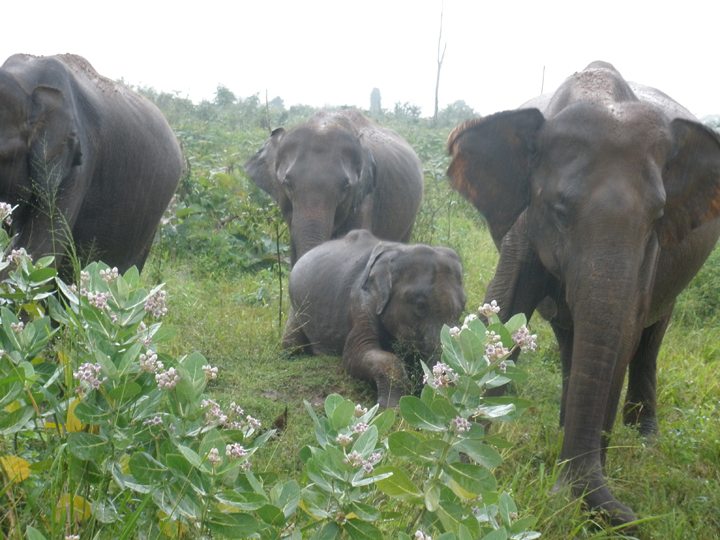
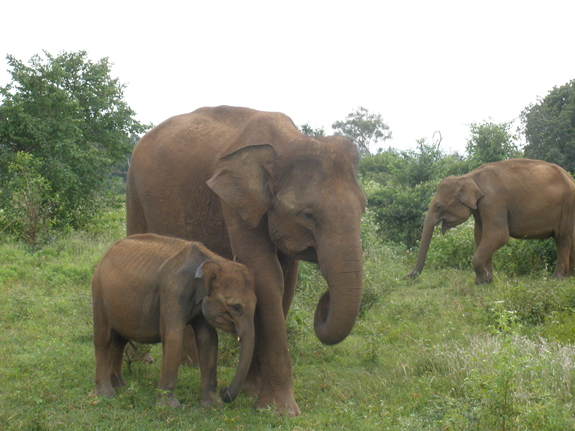
Batik and her calf

Last Monday, Sameera and I underwent a grueling six-hour bus ride (each way) to the capital city of Colombo.  Dr. Padmalal, UWERP’s collaborator for this project from the Open University of Sri Lanka, had managed to secure the approval of my research permit, and we went to pick up the document.  The long hours of sweltering heat devoid of any bathroom breaks and punctuated by the blaring of obnoxiously loud horns were worth it.  The permit allows me to record elephant vocalizations, which is, after all, why I came here.  There is only one problem:  the elephants have barely been vocalizing at all.  In fact, they seem to be doing precious little besides eating and walking.  I know that patience is key of course, but it is hard not to become a little discouraged as I wonder whether I will eventually be able to get enough sound recordings to complete my Ph.D. Continue reading

First day

Guest post by Michael Pardo, Cornell University

Wild boar

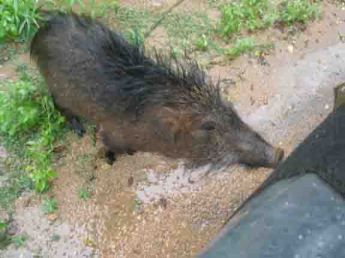
Curious boar.

December 18, 2012

A breathtaking expanse of bushes peppered with trees.   That is my first impression of Uda Walawe National Park as we pass through the entrance gate in the early hours of the morning.  The shrubs grow densely packed on either side of the ochre-colored road, like a vertically challenged forest.  They are interspersed with teak saplings, a reminder of the days when this park was a timber plantation.  Towering banyan trees soar above the surrounding vegetation, peacocks perched in their uppermost branches.  In the distance, I can see the blue mountains and waterfalls of Nuwara Eliya, and above them, a steely sky striated with rain-laden clouds.  A grey mongoose crosses the road ahead of us, stopping briefly to stare at our jeep before disappearing into the wall of greenery.  Flocks of Common Mynas and Spotted Doves spring into the air as we rumble past.

Continue reading