Mating pandemonium

Leakey mounts

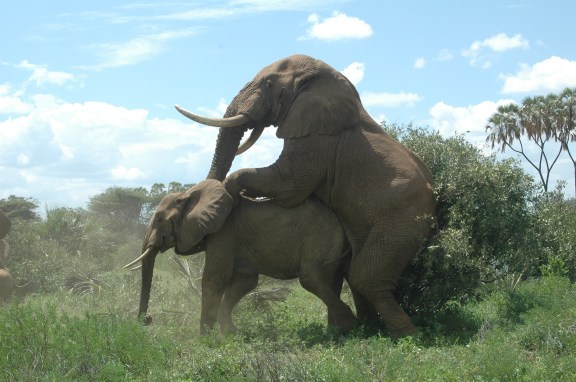
Leakey, one of the largest old bulls to appear in the Samburu population, mates with Nicky of The Artists.

Male elephants continue to grow throughout their lives, getting bulkier and broader. Older males enjoy a greater competitive advantage and higher reproductive success. Many have a characteristic time of year when they are seeking mates, and as they get older they increasingly advertise their state with strong-smelling chemical signals in their urine and temporal secretions in a condition termed ‘musth’. Younger bulls, who don’t appear to be signaling consistently or at all, may also try their chances when a receptive female is available.  But they are prone to being chased off by the bigger, more dominant males.

Continue reading

A wall of elephants

December 9 2012, Samburu

A rainstorm fills the Ewaso Nyiro river. True to its name, the water is a rich orange-brown and as thick as Thai iced tea. It gurgles alongside the camp, snaking past wide sandy banks with steep sides like miniature beaches bordered by miniature cliffs.

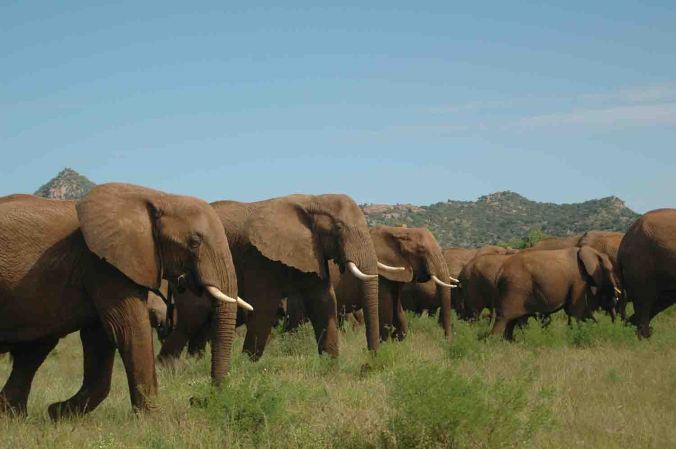
To see the elephants, the river and its shaded woodland border is the place to be in the dry season.  But these days, with water puddling up everywhere elephants are ranging further from it. The other day we came upon a vast herd on the bank. Gathered in its ranks were multiple families, but on the following days hardly anyone came down again except to cross to the other side.

A vast herd marches in unison.

A vast herd marches in unison.

Continue reading

Asian elephant imitates Korean speech

Koshik is a 12-year-old male Asian elephant housed at the Everland Zoo in South Korea.  For some years he had been a local star that was the subject of some internet fame due to his uncanny ability to produce human-like sounds.  Not only this, but they actually seemed to resemble Korean words.

In a new paper in the journal Current Biology by Angela Stoeger and colleagues, Koshik’s vocalizations were put to the test.  Could he really produce words, as trainers claimed?

The researchers recorded Koshik’s special utterances and played them back to a panel of native Korean speakers who had never heard him before. These participants did not know who was producing the sounds or what they were supposed to mean. They were then asked to write down the words they heard.  They found that Koshik’s call resembled five Korean words: ‘‘annyong’’ (hello), ‘‘anja’’ (sit down), ‘‘aniya’’ (no), ‘‘nuo’’ (lie down), and ‘‘choah’’ (good).  He appeared to be very good at reproducing the vowels in each of the words, but the consonants were more problematic.  “Choah” for instance was interpreted sometimes as “boah” (look) and “moa” (collect) by the human listeners.

Continue reading

The Twilight Visit of Ghost

*Note from SdS: the following is an account based on Sameera’s experience. I’ve come to think of this mysterious tusker as ‘Ghost’ because we so rarely see him and know so little about him. The name has stuck in my head, so that’s going to be his nickname from now on.

– 27 November 2011 –

It was about 2 o’clock in the morning when I woke up to the sound of something brushing past the pipes outside. It was near the water tank. As I listened harder, I began to make out a distinctive sound – an elephant eating.

Walking over to the window, I could just make out the dark bulk of a big male. I was by myself in the field station, sleepy and tired, but very quickly I became alert. Our housekeeper, who usually sleeps on a bed on the porch, had gone home for the weekend. I was glad about this because I thought he surely would have turned on the lights and scared off our visitor.
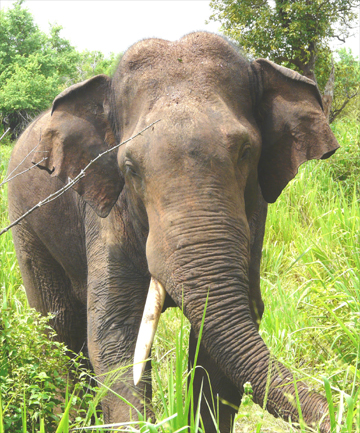
Tusker “209” which seems to have been translocated into Uda Walawe National Park in early 2010.

For months we had seen and heard evidence of elephants breaking through the electric fence, but despite numerous attempts they were impossible to find and track down once they got into the sugar cane across the road. There were at least four elephants responsible, people thought. At least one of them was a one-tusked male. We suspected it was an animal that had been translocated into the park last year, but had not been able to verify this. This was an important chance to catch one of the culprits in the act. Continue reading

Sharing shade

I spend a lot of time looking at elephant photos.  Now and then, I see something that makes me smile.  I just came across a set of pictures from back in May of 2009, which prompted this post.

One of the neatest things about the elephants at Uda Walawe is how habituated many of them are.  What does habituation mean?  When studying an animal’s behavior, it’s important that the presence of an observer doesn’t change its behavior.  It has to go about its business as if you weren’t there – or at least, not minding your intrusion.  Unhabituated animals are fearful, and we can easily tell that some of the elephants in Uda Walawe are not used to people at all.  But others we know very well – and maybe, they know us too?

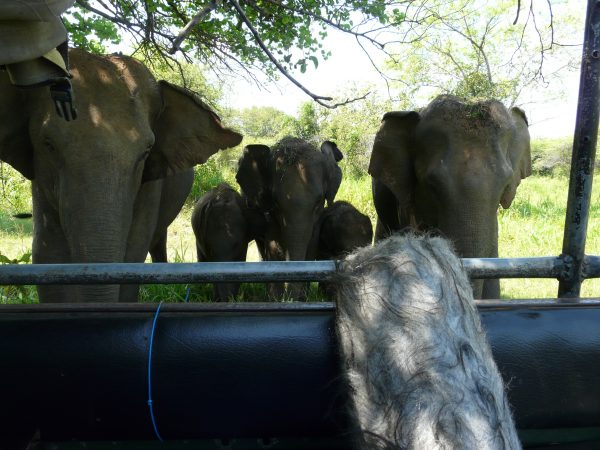
The S unit is one such group.  The ‘S’ stands for Seenuggala, which is the name of a little reservoir inside the park around which we frequently see them.  This is one of the largest social units in our study.  One hot morning in May of 2009, we came across them scattered about under trees trying to avoid the sun, as elephants do in the middle of the day.  We ourselves pulled up to some shade by the side of the road, from where we could watch them.  We knocked off the engine and waited.

The ellies and we, escaping the heat beneath the same tree.

Continue reading

The Magnificence of Mud

It’s October, and the monsoon is in full force.  As we wrote in an earlier post the elephants love mud.  They’re just oversized piggies with big floppy ears.  Here’s a video for your amusement:

Why do they love mud so much?  As anyone who has seen or enjoyed a muddy spa retreat can tell you, it’s good for the skin and helps with thermoregulation.  Because elephants don’t sweat, when it’s hot outside the evaporating mud cools them off.  Rudyard Kipling so mischievously wrote in ‘The Elephant’s Child’:

‘Don’t you think the sun is very hot here?’ [says the Rock Python]

‘It is,’ said the Elephant’s Child, and before he thought what he was doing he schlooped up a schloop of mud from the banks of the great grey-green, greasy Limpopo, and slapped it on his head, where it made a cool schloopy-sloshy mud-cap all trickly behind his ears. Continue reading

The Social Lives of Asian Elephants

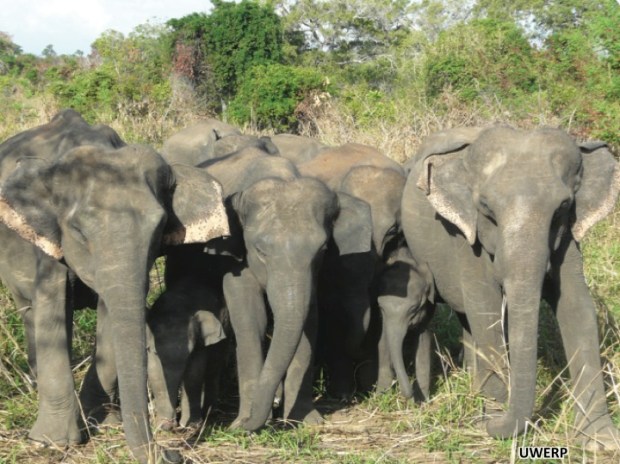
Kanthi (far left) and Kamala (far right) were the most inseparable pair of elephants we saw during the study. Members of their social group, the K unit, were often together whenever they were seen.  Yet not all social units were so tightly knit, with individuals being scattered into small groups quite far apart.

Kanthi (far left) and Kamala (far right) were the most inseparable pair of elephants we saw during the study. Members of their social group, the K unit, were often together whenever they were seen.  Yet not all social units were so tightly knit, with individuals being scattered into small groups quite far apart.

Male and female Asian elephants form distinct parallel societies in which adult females and calves move together and form visible groups whereas adult males are typically more solitary.  For many years there have been two somewhat conflicting characterizations of female Asian elephant society.  The classic view, popularly held, is that Asian elephants form very tightly-bonded families centered around older adult females known as matriarchs.  This view is adapted wholesale from the many excellent long-term studies of African savannah elephants [1-3], which do exhibit this type of social organization. Continue reading

The Mystery Orphan, Part 1

By Ashoka Ranjeewa

– January 28 2011, 3:00 PM –

The newborn calf stayed close to a subadult female, who was very attentive to her.

It was a rainy afternoon. I met Fat-tail with a group at the crest of the Teak waterhole. Amidst the heavy downpour, they were grazing and moving towards Old Mau-Ara Road which is located on the North-east side of the park. When we neared them, Fat-tail came over and stood right next to the jeep.  She was watching us, but it was a friendly look. Fat-tail and Right-hole were part of one of the largest social units we had documented in the past five years – the Rs, named after the oldest female among them, Ragged Ear.  This unit had quite a few adults in it, but the split up during wet seasons.  Fat-tail and Right-hole were a pair that were nearly always seen together and that day was no exception, they were both together along with the calves.

Fat-tail with her juvenile calf.

After few minutes I saw a newborn female calf who was being nursed by a subadult female. Lacking milk, the teenager was unable to actually feed calf. The calf was very tiny, still having the red skin and eyes characteristic of newborns, though covered by lots of hair. It was very active and always moved under the belly of the subadult, though she was definitely too young to be the mother of the calf. I wondered who the mother was. Neither Right-hole nor Fat-tail could be the mother – Right-hole had her own small calf with her.  Fat-tail had had a newborn calf, but sadly, it had died a few months ago though she still had her older calf. She couldn’t give birth to a new calf yet since its takes 22 moths for a pregnancy so the interval between calves is usually at least four to five years. I got  very curious about who the newborn could belong to.
Continue reading

Lending A Helping Trunk

Natural selection generally promotes the success of individuals who look out for themselves – that is, selfishly.  But, there are also lots of examples of cooperative behavior in nature: for instance, the care of offspring, hunting, and sometimes, even problem solving.  This is because cooperation can be beneficial as well – being able to raise young successfully and leave more descendants, or simply enhance one’s own survival by working together to obtain food or other resources.

The experimental set up, from Plotnik et al. 2011

Continue reading

The Elephant’s Chirp

Given the previous post about what shall now infamously be known as the incident of 2011, I thought it would be nice to lighten things up by sharing our other experiences with males in musth. Moreover, this is about one of those moments every scientist lives for: discovery.

First of all what is ‘musth’?  Musth is a condition that male elephants undergo after their teens which is similar to rutting in sheep and deer, in which males spend most of their time trying to find reproductive females and battling other males for dominance.  Hormonally, it means they are pumped full of testosterone.  Typically a male has to be in very good body condition to enter musth, and the older he is the longer it can last – several months in some cases – and during that time he eats very little.  You know a male is in musth when he shows reddish wet patches on the sides of his temples (just behind the eyes), and dribbles urine.  Oh yes – and he also smells to high heaven (some of us happen to think it smells rather good, musky sweet and thick…but then again, some of us also like the smell of Durian).
Continue reading