Ethimali Finds Her “Forever Home” In The Wild

by DJ, USW, and SdS (Photos by DJ &UWERP)

The female orphaned elephant calf found in Ethimale, Southern Sri Lanka rescued and brought to Elephant Transit Home (ETH), Udawalawa was later named Ethimali. After several years of rehabilitation, she was released to Uda Walawe National Park in March 2004, when she was about 4 years old, with another 10 rehabilitated juveniles.

Some young females at the ETH show an array of maternal or allomothering characters from an early age, despite being orphans themselves. They seem to select calves out of new arrivals and try to be as attentive to them as possible. She frequently checks whether her orphan is alright and will be the first to respond if the orphan screams or is attacked by another calf. She keeps continuous company for the orphan and with time, it starts to follow her most of the day. When the orphan seeks comfort she allows it to suck on her – in the absence of real milk, even the tip of an ear will do!

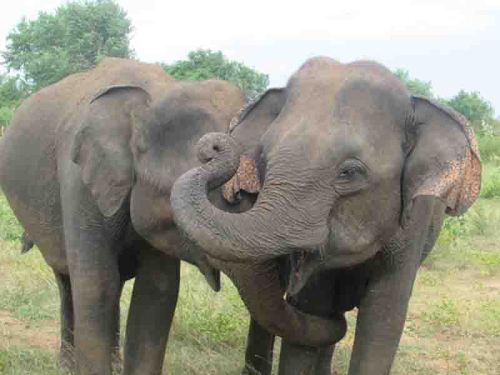
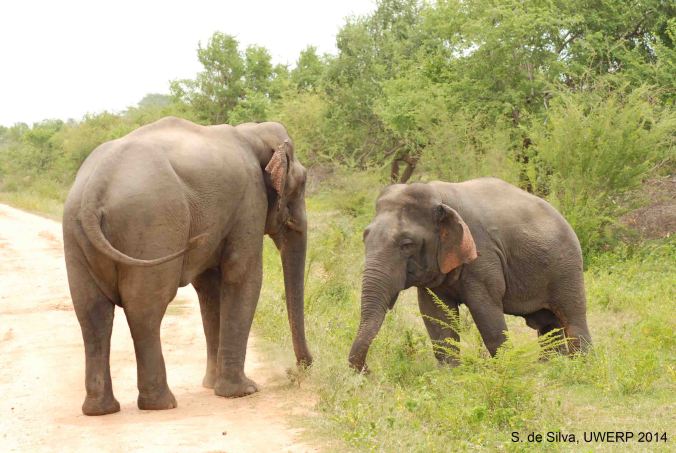
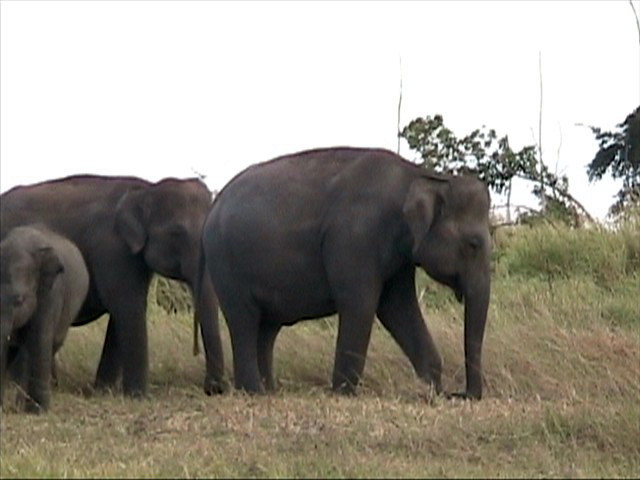
Ethimali (wearing a belt around the neck) with Mahee, a wild adult female and her calf.

Ethimali (wearing a belt around the neck) with Mahee, a wild adult female and her calf in 2004.

Continue reading

Rehabilitated elephants can be good moms!

By Deepani Jayantha & Sameera Weerathunga

[208] and calf

[208] with her newborn calf in June

In August 2015, one of our frequently sighted females in Uda Walawe named Indika was seen suckling two calves of different ages on either sides of her. The younger male calf Indika was nursing was about three months old and merely skin and bones. He was obviously malnourished and weak. She already had a rounded and bulky belly suggesting another calf was on her way. This unusual behaviour of the elephants intrigued us so we dug deeper into our field notes.

It turned out he was not her calf – he had been born to [208] in June, 2015 and was the first calf we had witnessed her to have produced during our study. A few days after the birth she lost her interest in the new-born and may have stopped lactating. The calf’s body condition started gradually declining so our team informed the veterinary staff at the Elephant Transit Home. Continue reading

How will Asian elephants react to the sound of bees?

Guest post by Dr. Lucy King – Elephants & Bees Project, Save The Elephants

Apis Cerana, Photo by K. Raveendran

Apis Cerana, Photo by K. Raveendran

I’ve just returned home to Kenya after a fascinating month working with Dr Shermin de Silva and her team at the Uda Walawe Elephant Research Project in Sri Lanka. There have been several productive links between Dr de Silva’s project and ours at Save the Elephants over the years and key to the collaboration has been the ability to compare elephant population ecology between Kenyan and Sri Lankan elephants. However, I went to work in Uda Walawe National Park for an entirely different reason – bees! Continue reading

Facing The Threat Together

By Mickey Pardo, Cornell University & Open University of Sri Lanka

Down the Old Mau Ara Road we drove, my head swiveling left and right as I scanned for elephants on the grassy strips to either side.  Then we rounded a bend, and Lucy slowed to a stop in front of the herd standing thirty meters away.  It was a rather large group:  [472], [873], [075], and [151], along with a number of sub-adults and juveniles.  [151] and a sub-adult female approached slowly to within a few meters of our jeep.

Mickey_elephants1

RAAAAAAAHHHHHHH!  With no warning, they bellowed in our faces in deafening unison! Continue reading

Dwarf elephant battles musth male!

16 June 2014 – S. de Silva

Battle1A clear sunny day, Lucy and Mickey are off in the park with Sameera while Kumara and I stay behind to catch up on office work. It’s mid-morning when Sameera calls to tell us Walawe Kota is back!  Walawe Kota is the nickname we’ve given the dwarf elephant of Uda Walawe.  This would be at least the third year now. What’s more, he’s in musth and reportedly fighting another male.  At first, the news is a bit confusing – there’s mention of a possible injury.
I’ve never seen him in the flesh though Kumara and Sameera have. I’ve only seen pictures and video clips, so I’m eager to try our luck. The park office reports he’s been spotted not far from the entrance, so we hop in our Jeep and dash off in hopes he’s still out in the open. Continue reading

My first playback trial!

Bashi_&calf

By Mickey Pardo – Cornell University & Open University of Sri Lanka

Friday, May 23, 2014

Doing playback experiments with Asian elephants is harder than it would seem.  The basic idea is straightforward:  I want to know whether Asian elephants can distinguish between the calls of familiar and unfamiliar individuals, so I will play back recordings of familiar and unfamiliar elephants and see if the subjects react differently to them.  But in order to do a playback, so many factors must align at the same time.  The right subject must be present, the original caller must not be present, the group can’t have been exposed to a playback for at least a week, the elephants have to be stationary, they have to be clearly visible and within 50 meters of the road, there can’t be any tourists nearby, and all of these requirements must hold true for at least 15 minutes straight.  Sometimes, it seems about as likely as having your winning lottery ticket reduced to cinders by a lightning bolt.

Continue reading

Where Are You? I’m Here!

 By Michael Pardo, Cornell University & Open University of Sri Lanka

From left to right: [802], [802]’s four-year old calf, and a sub-adult female resting (this was before they moved to join Tulita under the maila tree)

Tulita, [802], [802]’s calf, and a sub-adult female stood nearly motionless under the low-hanging canopy of the maila tree.  Their heads drooped low and their trunks rested on the ground as they huddled together in the shade, seeking respite from the blazing noonday sun.  The only movement was the occasional swish of a tail, in an attempt to swat away some pesky insect.  A group of jabbering tourists pulled up in a small caravan of jeeps, but the elephants paid them no heed. Suddenly, two low growls echoed across the road over the noise of the human onlookers—deep, rumbling sounds like the purring of a truck-sized cat.  They were followed by two roar-rumbles, more urgent-sounding vocalizations where a loud bellow precedes the softer rumbling component.  One more call emanated from the tall undergrowth before the sub-adult female finally answered it.  Her response was immediately answered in turn, initiating a brief exchange of vocalizations between the unseen elephant and the sub-adult under the maila tree.  As I scanned the shrubs expectantly, they soon parted, revealing the dust-covered forehead of a small female elephant.  The newcomer stepped fully out of the thorny vegetation, displaying ears with a noticeable flap in front and a long, narrow lobe.  It was Continue reading

Jackals and Turtles and Elephants, Oh My!

By Michael Pardo, Cornell University 

Monday, March 3, 2014

mpardoblog2ele

[174], [036] and their calves spotted at Teak Reservoir

Sometimes it’s easy to become so focused on elephants that I forget about the other fascinating creatures that share their habitat.  This afternoon, we were watching [174], [036], and their calves at the edge of the Teak Reservoir when a large gaggle of tourist jeeps frightened them off.

We decided to stay put for a few minutes after the tourists left, in the hope that the elephants might return.  No such luck, but our patience was rewarded with something else. Continue reading

The Mystery Orphan, Part 1

By Ashoka Ranjeewa

– January 28 2011, 3:00 PM –

The newborn calf stayed close to a subadult female, who was very attentive to her.

It was a rainy afternoon. I met Fat-tail with a group at the crest of the Teak waterhole. Amidst the heavy downpour, they were grazing and moving towards Old Mau-Ara Road which is located on the North-east side of the park. When we neared them, Fat-tail came over and stood right next to the jeep.  She was watching us, but it was a friendly look. Fat-tail and Right-hole were part of one of the largest social units we had documented in the past five years – the Rs, named after the oldest female among them, Ragged Ear.  This unit had quite a few adults in it, but the split up during wet seasons.  Fat-tail and Right-hole were a pair that were nearly always seen together and that day was no exception, they were both together along with the calves.

Fat-tail with her juvenile calf.

After few minutes I saw a newborn female calf who was being nursed by a subadult female. Lacking milk, the teenager was unable to actually feed calf. The calf was very tiny, still having the red skin and eyes characteristic of newborns, though covered by lots of hair. It was very active and always moved under the belly of the subadult, though she was definitely too young to be the mother of the calf. I wondered who the mother was. Neither Right-hole nor Fat-tail could be the mother – Right-hole had her own small calf with her.  Fat-tail had had a newborn calf, but sadly, it had died a few months ago though she still had her older calf. She couldn’t give birth to a new calf yet since its takes 22 moths for a pregnancy so the interval between calves is usually at least four to five years. I got  very curious about who the newborn could belong to.
Continue reading

Blanche’s baby

July 28th 2006 – – –

It’s the height of the dry season, and this year the reservoir is full of elephants.  Last year, they didn’t come down at all – on my very last day in August, I saw just one group crossing it in a hurry.  This year, around every corner there is a large group of elephants.  There must have been several hundred animals altogether, including calves. It’s almost like what I’ve read of African elephants – but these groups are very distinctly separated.  The individuals in them don’t seem to be there by chance.  Instead, there are certain elephants who seem to be found ‘together’ a lot of the time, though not always.  Were they families?  Extended families?  Who knew.

Continue reading