Watch Shermin’s talk “The Secret Society of Asian Elephants” here:
Senate hearing on Ivory and Global Insecurity – Comments by Kate Nowak
Today there was hearing in the U.S. Senate foreign relations committee on the issue of “Ivory and global insecurity,” chaired by Senator John Kerry (D-Massachusetts). In attendance were Senator Chris Coons (D-Delaware), and Senator Mark Udall (D-Colorado). Testimony was provided by Dr. Iain Douglas-Hamilton, Founder of Save the Elephants; Mr. Tom Cardamone, Managing Director of Global Financial Integrity; Mr. John Scanlon, Secretary General of the Convention on International Trade in Endangered Species of Wild Fauna and Flora (CITES).
This is a guest commentary by Katarzyna Nowak, co-director of the Udzungwa Elephant Project and lecturer in Ecology and Evolutionary Biology at Princeton University. Continue reading
Trackways freeze time to reveal ancient elephant sociality

An artist’s reconstruction of what the ancient herd may have looked like, here showing Stegotetrabelodon
The evolution of behavior is tricky to study for one very simple reason: behaviors usually don’t fossilize. While anatomy can be reconstructed based on skeletal remains and imprints, how might one glimpse how a living, breathing organism behaved millions of years ago? Continue reading
If you’ve seen one elephant, have you seen them all?
“A horse is a horse” – but is any elephant just another elephant?
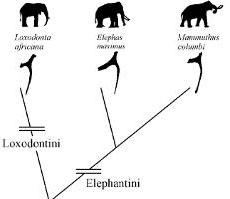
A cladogram showing the relationships between the African elephants (genus Loxodonta), Asian elephants (genus Elephas) and pleistocene woolly mammoths (genus Mammuthus) based on the hyoid bone, which is located in the neck. Figure from Shoshani & Tassy 2004.
Few people realize that Asian and African elephants are about as different from one another as we are from chimpanzees. That’s not an exaggeration – the estimated time that they diverged from a common ancestor is about six million years ago [1], whereas humans and chimpanzees are estimated to have diverged between five to six million years ago [2]. Some have even suggested that Asian elephants may be more closely related to woolly mammoths (Mammuthus primigenius).
It’s ok if this surprises you – the elephants may appear to resemble one another more closely in appearance and sound than humans and chimpanzees.
But what about their behavior?  Continue reading
The Twilight Visit of Ghost
*Note from SdS: the following is an account based on Sameera’s experience. I’ve come to think of this mysterious tusker as ‘Ghost’ because we so rarely see him and know so little about him. The name has stuck in my head, so that’s going to be his nickname from now on.
– 27 November 2011 –
It was about 2 o’clock in the morning when I woke up to the sound of something brushing past the pipes outside. It was near the water tank. As I listened harder, I began to make out a distinctive sound – an elephant eating.
Walking over to the window, I could just make out the dark bulk of a big male. I was by myself in the field station, sleepy and tired, but very quickly I became alert. Our housekeeper, who usually sleeps on a bed on the porch, had gone home for the weekend. I was glad about this because I thought he surely would have turned on the lights and scared off our visitor.
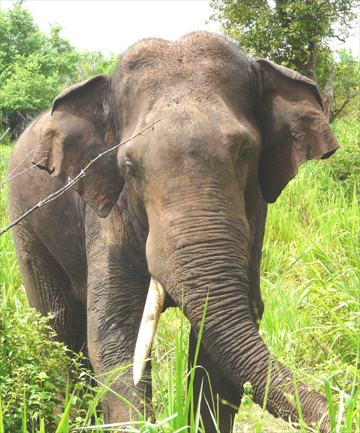
Tusker “209” which seems to have been translocated into Uda Walawe National Park in early 2010.
For months we had seen and heard evidence of elephants breaking through the electric fence, but despite numerous attempts they were impossible to find and track down once they got into the sugar cane across the road. There were at least four elephants responsible, people thought. At least one of them was a one-tusked male. We suspected it was an animal that had been translocated into the park last year, but had not been able to verify this. This was an important chance to catch one of the culprits in the act. Continue reading
Join The Elephant March – Say NO To Ivory!
10 Days Left To Help Elephants & Us!
Haven’t gotten around visiting our RocketHub fundraiser page yet? There’s still time! But hurry – we’ve only got till December 15th!
Many thanks to Marion Bricaud all the way from France for donating this lovely artwork (check out more of her art at http://polymorphicgirl.deviantart.com/)!

That’s what you’ll get if you donate at the $150 level (without the watermark, of course). I’ve also added another reward at $250 – an original ink elephant drawing by yours truly! There are lots of rewards at levels above and below this, so check them out & help us help elephants:
http://www.rockethub.com/projects/3707-helping-elephants-and-people-coexist
Sharing shade
I spend a lot of time looking at elephant photos. Now and then, I see something that makes me smile. I just came across a set of pictures from back in May of 2009, which prompted this post.
One of the neatest things about the elephants at Uda Walawe is how habituated many of them are. What does habituation mean? When studying an animal’s behavior, it’s important that the presence of an observer doesn’t change its behavior. It has to go about its business as if you weren’t there – or at least, not minding your intrusion. Unhabituated animals are fearful, and we can easily tell that some of the elephants in Uda Walawe are not used to people at all. But others we know very well – and maybe, they know us too?
The S unit is one such group. The ‘S’ stands for Seenuggala, which is the name of a little reservoir inside the park around which we frequently see them. This is one of the largest social units in our study. One hot morning in May of 2009, we came across them scattered about under trees trying to avoid the sun, as elephants do in the middle of the day. We ourselves pulled up to some shade by the side of the road, from where we could watch them. We knocked off the engine and waited.
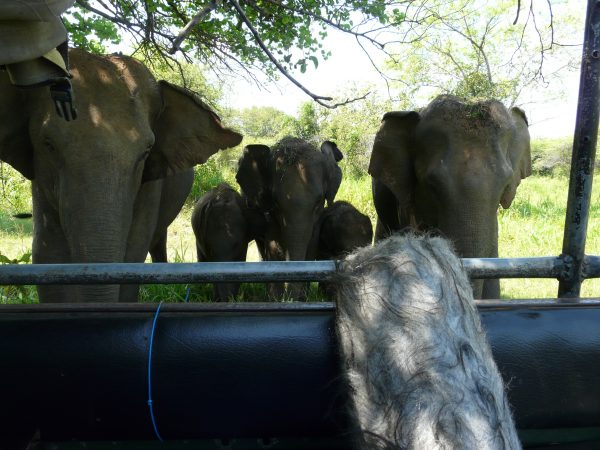
The ellies and we, escaping the heat beneath the same tree.
We’re part of the #SciFund challenge!
There are at least two kinds of science today – a) the kind that requires millions of dollars, a small army of techs and postdocs, and many fancy doo-dats or whatsits and b)everything else. The latter doesn’t do too well in today’s funding climate, which is geared toward funding BIG EXPENSIVE science. A small group of scientists – mostly students – are trying to change all that by appealing directly to the public to fund small, very cool, science projects and earn a nifty little reward of thanks. The projects are diverse – everything from zombie fish to next-generation algae technology. The result: The #SciFund Challenge! Help us help elephants – and help science along the way!
WANT TO HELP?
http://www.rockethub.com/projects/3707-help-us-help-elephants-people-in-sri-lanka
Please share the link above to help us reach our goal!
Check out all the other projects here:
The Magnificence of Mud
It’s October, and the monsoon is in full force. As we wrote in an earlier post the elephants love mud. They’re just oversized piggies with big floppy ears. Here’s a video for your amusement:
Why do they love mud so much? As anyone who has seen or enjoyed a muddy spa retreat can tell you, it’s good for the skin and helps with thermoregulation. Because elephants don’t sweat, when it’s hot outside the evaporating mud cools them off. Rudyard Kipling so mischievously wrote in ‘The Elephant’s Child’:
‘Don’t you think the sun is very hot here?’ [says the Rock Python]
‘It is,’ said the Elephant’s Child, and before he thought what he was doing he schlooped up a schloop of mud from the banks of the great grey-green, greasy Limpopo, and slapped it on his head, where it made a cool schloopy-sloshy mud-cap all trickly behind his ears. Continue reading
 Maximus