Six year update on the Uda Walawe elephants

The Uda Walawe Elephant Research Project is now approaching eight years, a unique study of Asian elephants.  Because elephants are such long-lived animals, it takes a long time to understand them – particularly for important variables like who reproduces and how often.  Studies of wild African elephants have been conducted at multiple sites over 10 years or more (in some cases as many as 40!), but this has not been the case for the Asian species in the wild. There have been long-term records of Asian elephants  populations in captivity from places like Myanmar, where they have long been used in timber camps, and it’s interesting to see how the two compare.

This past December we published a comprehensive paper analyzing six years of data on the wild Asian elephants of Uda Walawe National Park, Sri Lanka. This paper is one of a kind as it has been difficult for researchers to successfully monitor wild Asian elephants due to the difficulty of their habitats, and the logistical challenges of conducting steady research over longer time periods.
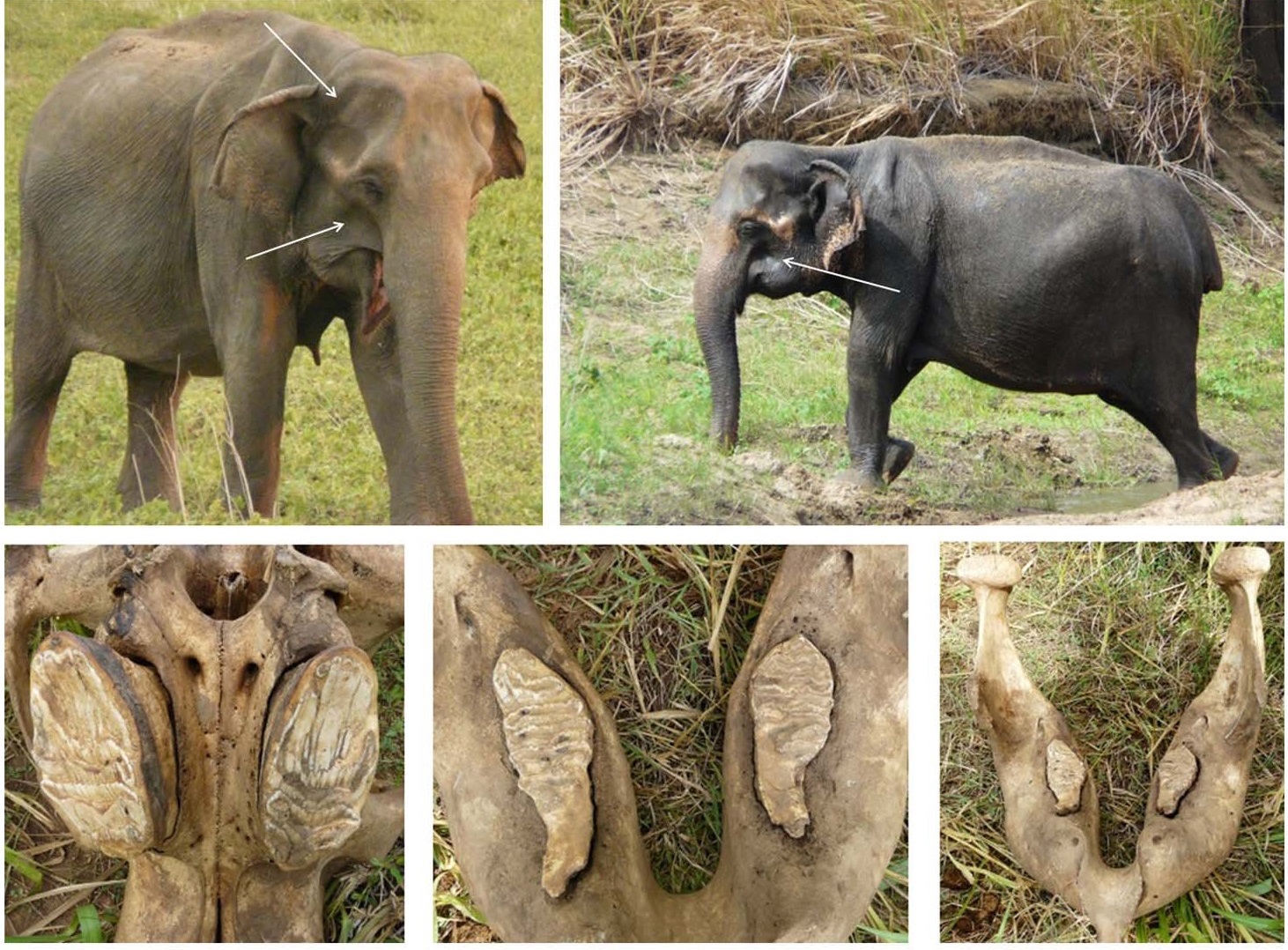
Tailless was one of the venerable elders of our population. She was especially important for this study for two reasons: she was unmistakable even after dying due to her uniquely broken tail, and her jaw was recoverable. The wear on her teeth showed her age to be around 60 or more, meaning female elephants in Uda Walawe can potentially live out their full lifespans.

Tailless was one of the venerable elders of our population. She was especially important for this study for two reasons: she was unmistakable even after dying due to her uniquely broken tail, and her skull and jaw were recoverable. The wear on her teeth showed her age to be around 60 or more, meaning female elephants in Uda Walawe can potentially live out their full lifespans. We aged other females in the population relative to Tailless.
Continue reading

Field notes

Baretail’s Tale

By TV Kumara

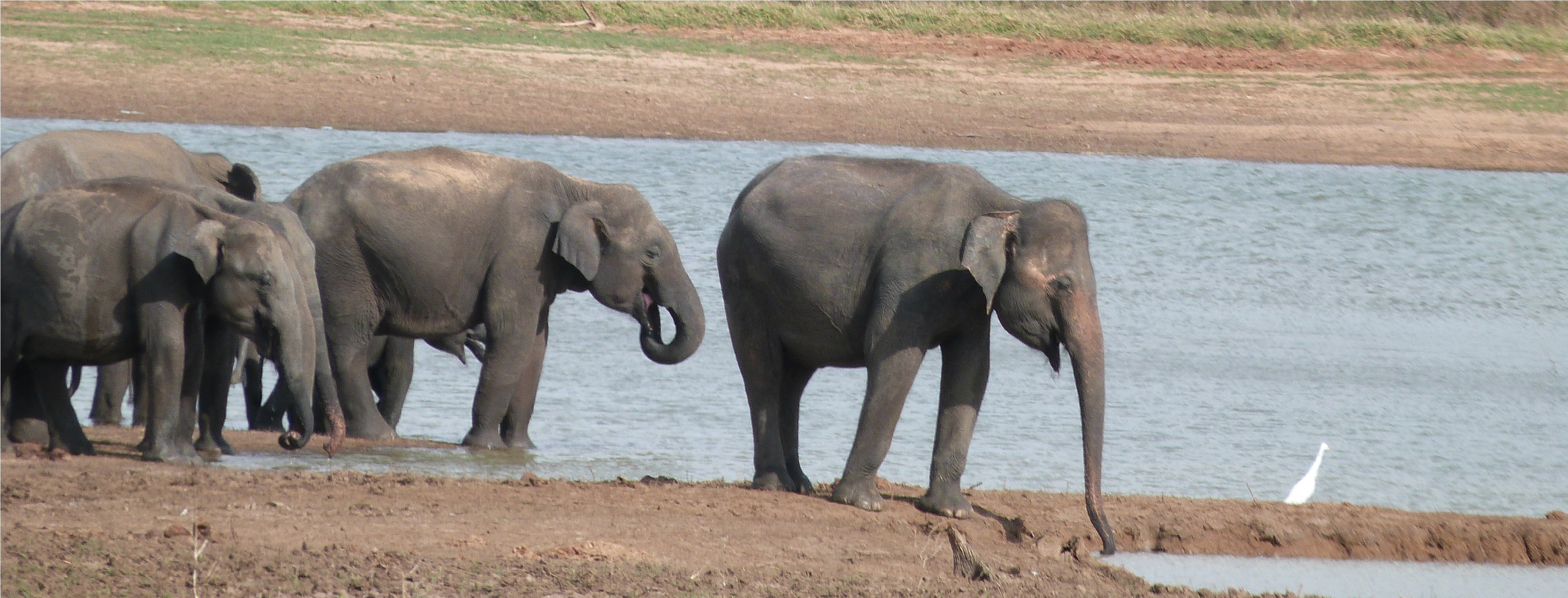
Baretail with the Bs at the Uda Walawe reservoir.

Baretail (right) with the Bs at the Uda Walawe reservoir.

Baretail is a female elephant in Uda Walawe National Park (so named as her tail has no hair). She is a member of ‘B’ unit, because ‘B’ is the first letter in names – e.g. Baretail, Batik, Bali, Bashi, Blanche, Bitsy and Bianca. Continue reading

Help Support Michael Pardo’s “Elephant Grammar” Project!

By Michael Pardo, Cornell University

The first time I saw wild Asian elephants was last December, in Uda Walawe National Park, Sri Lanka.  As a first year Ph.D. student at Cornell University, I was trying to come up with a project, and was considering this park as a potential field site.  I was struck by the sheer variety of sounds that the elephants made.  Yes, they gave the well-known trumpets, but they also produced roars that carried for miles, rumbles so low-pitched that my human ears could barely detect them, and squeaks that sounded more like a dog’s chew toy than an elephant.  Why do these animals have so many different calls?  What do these calls mean?  The truth is, no one knows.  In fact, we know surprisingly little about how Asian elephants behave in the wild—even less than we know about their African cousins.  I’ve made it my business to uncover some of the secrets of Asian elephant communication—and hopefully get my Ph.D. in the process! Continue reading

EARS ID Database released

ears

We are pleased to release EARS (Elephant Attribute Recording System), designed by intern Ilja Van Braeckel. EARS is an MS Access database that permits quick searching of elephant ID photos. Users enter new ID features using a simple Excel worksheet which can be copied directly into Access. They can then query the database with a set of check-boxes for prominent natural features of individuals, which returns matching IDs and photos.  This should narrow the search substantially and cut down search time.  We recommend that a separate set of high-resolution ID photo files are maintained in parallel at another location and that once the search is narrowed final identifications are confirmed using these external files. The idea is for the database to aid, not replace, more detailed photos and human memory.

We share this tool freely hoping it will help others conduct individual-based studies of Asian elephants, and modifications may be made as required. Variations of it may also be useful for other species and contexts.

The database, excel sheet and a user manual can be found at:

http://trunksnleaves.org/resources.html

de Silva S, Webber CE, Weerathunga US, Pushpakumara TV, Weerakoon DK, et al. (2013) Demographic Variables for Wild Asian Elephants Using Longitudinal Observations. PLoS ONE 8(12): e82788. doi:10.1371/journal.pone.0082788

The “Elephant Grammar” Project at Uda Walawe National Park

By Mickey Pardo, Cornell University

Do Asian elephants have grammar?  I aim to find out why Asian elephants combine different calls into sequences by recording vocalizations, playing them back to the elephants, and observing their responses.  From January to July 2014 I will collect video and audio recordings of the elephants in Uda Walawe National Park, Sri Lanka, and I will also conduct some preliminary playback experiments to determine the meanings of different calls.  However, this work is extremely expensive, and because my research is not covered by my advisor’s grants, I am responsible for funding 100% of my project on my own.  To help raise the money I need, I have started a crowd funding campaign on the platform Microryza.  The idea is to raise a significant amount of money via many small donations.  The funds that I raise through this campaign will be used to help pay for 4×4 vehicles that I need to transport myself, my field assistants, and my equipment inside the park.  If you donate to my campaign, I will send you periodic updates from the field, including photos and videos of the elephants I study.  Here is a link to my project:  https://www.microryza.com/projects/do-asian-elephant-calls-have-grammar-like-elements

You can find previous posts from the field at the links below:

How to study social networks in elephants

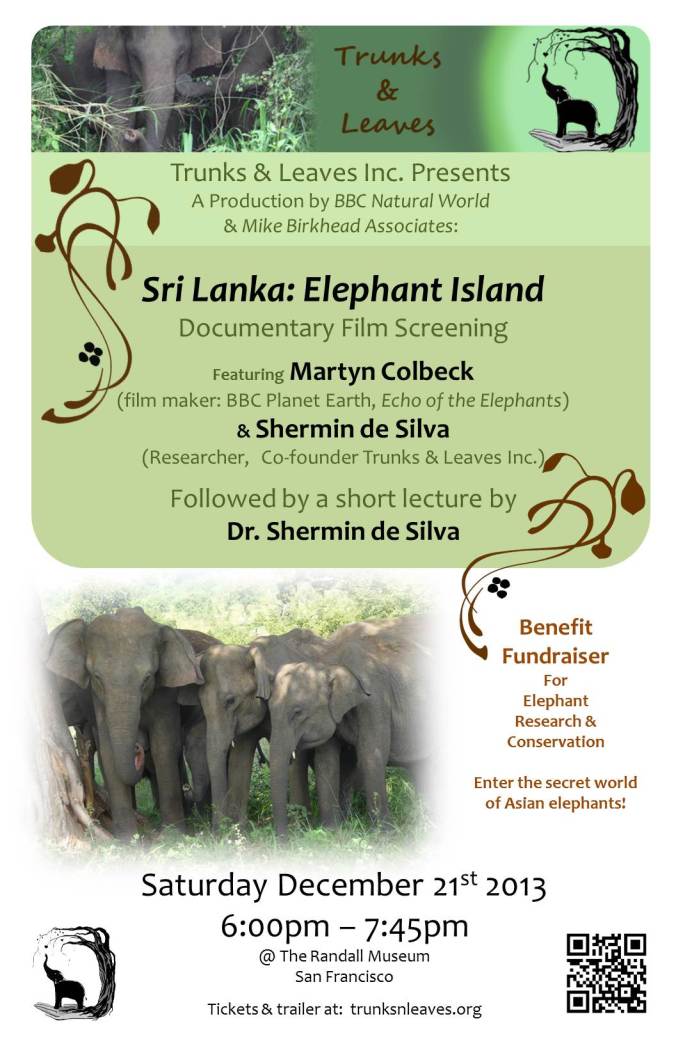
Another nice summary of our work by Pleuni Pennings. Don’t forget to join us on December 21st at the Randall Museum if you are in San Francisco!

pleunipennings's avatarBeing A Better Scientist

Elephants are smart and social, and sometimes they seem very much like humans, for example when they mourn their dead. Long term research by Shermin de Silva and colleagues (BMC Ecology, 2011) showed that their friendships are also very much like ours.

Who is she hanging out with?

Shermin and her colleagues observed 286 female elephants over 20 months in Uda Walawe National Park in Sri Lanka. Every time the field crew saw one of the elephants, they noted who she was with. The data could later be analyzed using tools from network analysis.

How to recognize 286 elephants?

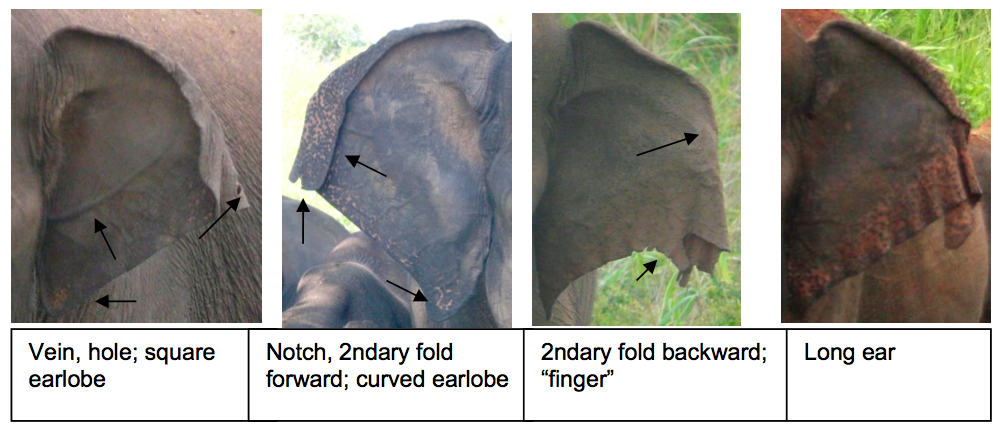
But wait a second, 286 elephants … that’s a lot of elephants to remember. You may wonder how recognizing so many individual elephants is even possible for Shermin and her crew. Well, the answer is twofold. First of all, all elephants have different ears. Second, Shermin and her colleagues…

View original post 498 more words

An Evening With Elephants

pleunipennings's avatarBeing A Better Scientist

I am trying out something new this month: I am hosting a fundraising event!

The event will take place on December 21st in San Francisco in the Randall Museum. We’ll show a BBC movie about elephants in Sri Lanka (trailer) and my friend Shermin de Silva will give a talk about her work with these same elephants.

Shermin de Silva

Shermin is an inspiring woman. She runs a field station in Sri Lanka, works in the United States (she is a postdoc in Fort Collins) and manages to raise enough money to keep her research going. This, as you can imagine, is not easy!

Her research is interesting, because she is one of few people who follows individual elephants in a wild Asian elephant population over time. Because she and her field crew know the individual elephants, they can see when elephant friendships form and break. It…

View original post 239 more words

Linnaeus’ Asian elephant – or not?

Very recently, an article from the Zoological Journal of the Linnaean Society was released regarding the mix-up of Linnaeus’ identification of the species Elephas maximus, or the Asian elephant. In 1764 Linnaeus documented a preserved elephant fetus (which is held today at the Swedish Museum of Natural History in Stockholm) as E. maximus in his studies. He believed it to have originated in Ceylon, now Sri Lanka, and this was long established as the so-called ‘type’ specimen of the species. Since Linnaeus never distinguished between Asian and African elephants, the true identity of the fetus has been in question and many suspected it to resemble the African species. Cappellini et al. decided to put the issue to rest and conducted ancient protein and DNA sequencing analysis to determine the true identity of the elephant fetus syntype. It just so happens that the fetus is in fact of the African elephant, in the genus Loxodonta.

An illustration of the elephant fetus from the Swedish Museum of Natural History referred to by Linnaeus

An illustration of the elephant fetus from the Swedish Museum of Natural History referred to by Linnaeus

This created quite a quandry because a new type specimen would have to be designated for reference, and according to the taxonomists’ rules, it could not be any arbitrary individual but preferably one that Linneaus had listed in his notes. At first it appeared a tooth fragment might be next possible canditate, which seemed rather unsatisfying since it was not an intact animal.  But luckily, Linnaeus had also cited a text by John Ray in which he describes the skeleton of an elephant. Apparently this skeleton, which had belonged to a touring performing elephant, is still intact at the Natural History Museum of Florence and was also thought to have originated from Sri Lanka. After analyzing the elephant skeleton’s DNA, Cappellini et al. were able to determine that the elephant was indeed the very specimen referred to in Linnaeus’ notes. E. maximus!

The E. maximus skeleton at the Natural History Museum of the University of Florence,

The E. maximus skeleton at the Natural History Museum of the University of Florence, the new type specimen if approved by the society.

Interested in learning more details on the Cappellini et al. article? Go here: http://www.nature.com/news/linnaeus-s-asian-elephant-was-wrong-species-1.14063

ResearchBlogging.org
Cappellini, E, A Gentry, E Palkopoulou, Y Ishida, D Cram, A Roos, M Watson,, US Johansson, B Fernholm, P Agnelli, F Barbagli, DTJ Littlewood, CD Kelstrup, JV Olsen, AM Lister, AL Roca, L Dalen, & MTP Gilbert (2013). Resolution of the type material of the Asian elephant, Elephas maximus Linnaeus, 1758 (Proboscidea, Elephantidae) Zoological Journal of the Linnaean Society, 1-10 DOI: 10.1111/zoj.12084

Asian elephants distinguish the calls of feline predator species

In September, Vivek Thuppil and Dr. Richard G. Coss from UC Davis published a paper in the journal Biology Letters regarding wild Asian elephant behavior towards pre-recorded tiger and leopard growls while attempting to crop raid. They found out that elephants silently retreat from tiger growls, but aggressively vocalize their presence when confronted with leopard recordings. According to previous research, tigers tend to prey on elephant calves while leopards are essentially harmless. This study is the first to investigate the inner-workings of elephant antipredator behavior at night.

Direction in which elephants emerge from the forest to trigger playback (courtesy of Vivek Thuppil)

Continue reading