The “Elephant Grammar” Project at Uda Walawe National Park

By Mickey Pardo, Cornell University
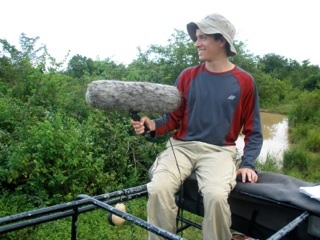
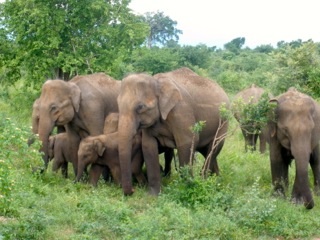
Do Asian elephants have grammar?  I aim to find out why Asian elephants combine different calls into sequences by recording vocalizations, playing them back to the elephants, and observing their responses.  From January to July 2014 I will collect video and audio recordings of the elephants in Uda Walawe National Park, Sri Lanka, and I will also conduct some preliminary playback experiments to determine the meanings of different calls.  However, this work is extremely expensive, and because my research is not covered by my advisor’s grants, I am responsible for funding 100% of my project on my own.  To help raise the money I need, I have started a crowd funding campaign on the platform Microryza.  The idea is to raise a significant amount of money via many small donations.  The funds that I raise through this campaign will be used to help pay for 4×4 vehicles that I need to transport myself, my field assistants, and my equipment inside the park.  If you donate to my campaign, I will send you periodic updates from the field, including photos and videos of the elephants I study.  Here is a link to my project:  https://www.microryza.com/projects/do-asian-elephant-calls-have-grammar-like-elements
You can find previous posts from the field at the links below:
Asian elephants distinguish the calls of feline predator species

In September, Vivek Thuppil and Dr. Richard G. Coss from UC Davis published a paper in the journal Biology Letters regarding wild Asian elephant behavior towards pre-recorded tiger and leopard growls while attempting to crop raid. They found out that elephants silently retreat from tiger growls, but aggressively vocalize their presence when confronted with leopard recordings. According to previous research, tigers tend to prey on elephant calves while leopards are essentially harmless. This study is the first to investigate the inner-workings of elephant antipredator behavior at night.

Direction in which elephants emerge from the forest to trigger playback (courtesy of Vivek Thuppil)

Continue reading

A Trunkful of Puzzles

By Lizzie Webber, University of Stirling 

2013: Sub-adults trunk wrestling with [t458] and [c458_12] nearby

2013: Sub-adults trunk wrestling with [t458] and [c458_12] nearby.

After studying the elephants in Uda Walawe National Park (UWNP) for three field seasons, many of their IDs and personalities are now firmly rooted in my memory. This has allowed me to continue unravelling some identity puzzles in my study while bridging together my field seasons from 2011, 2012 and 2013.

In 2013, [c458_12] (the calf of [458], born in 2012) was one of the most playful characters of the season. A male calf, he was often off with the older crew of juveniles and sub-adults (possibly cousins) who hung out with his family unit. Continue reading

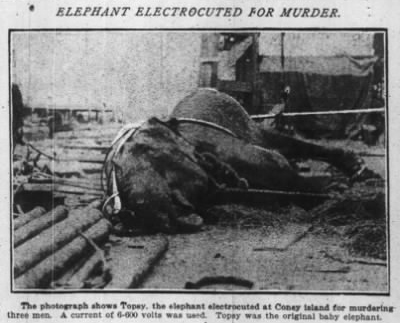
Elephants and electricity

Topsy the circus elephant, electrocuted in 1903 by Thomas Edison's technicians in carrying out her death sentence while demonstrating the dangers of AC current.

Topsy the circus elephant, electrocuted in 1903 by Thomas Edison’s technicians in carrying out her death sentence while demonstrating the dangers of AC current. Photo: Chicago Tribune

By Ilja Van Braeckel

New York, anno 1903. The city stirs as dawn breaks. Woken up by the distant rumble in the neighboring tenement, you might join the breakfast table. You might appreciate your morning cup of chicory root coffee and nibble on some hard-earned buttered toast. You might scratch your head and raise an eyebrow or two as you open the newspaper and read how none other than Thomas Edison electrocuted Topsy, the 28 year female Asian elephant. You might learn how the murderous ‘beast died without a trumpet or a groan’, in Edison’s slanderous attempt to discredit his rival’s discovery of alternating current, per demonstration of its potential hazard.

Uda Walawe today, some 14 000 km and 110 years away. Neither Topsy nor Edison outwitted the tusk of time and all that remains of the unfortunate elephalectric turn of events is the original video footage and the alternating current that proved innovative. In fact, electricity is now commonly used to separate humans from other animals and this is no different in Uda Walawe, where the national park is delimited by an electric fence line. In reality, however, frequent power cuts make its efficiency questionable to say the least and the elephants, keen creatures that they are, seem to have learned to jostle over the fence poles. Continue reading

Morning walk

By Ilja Van Braeckel

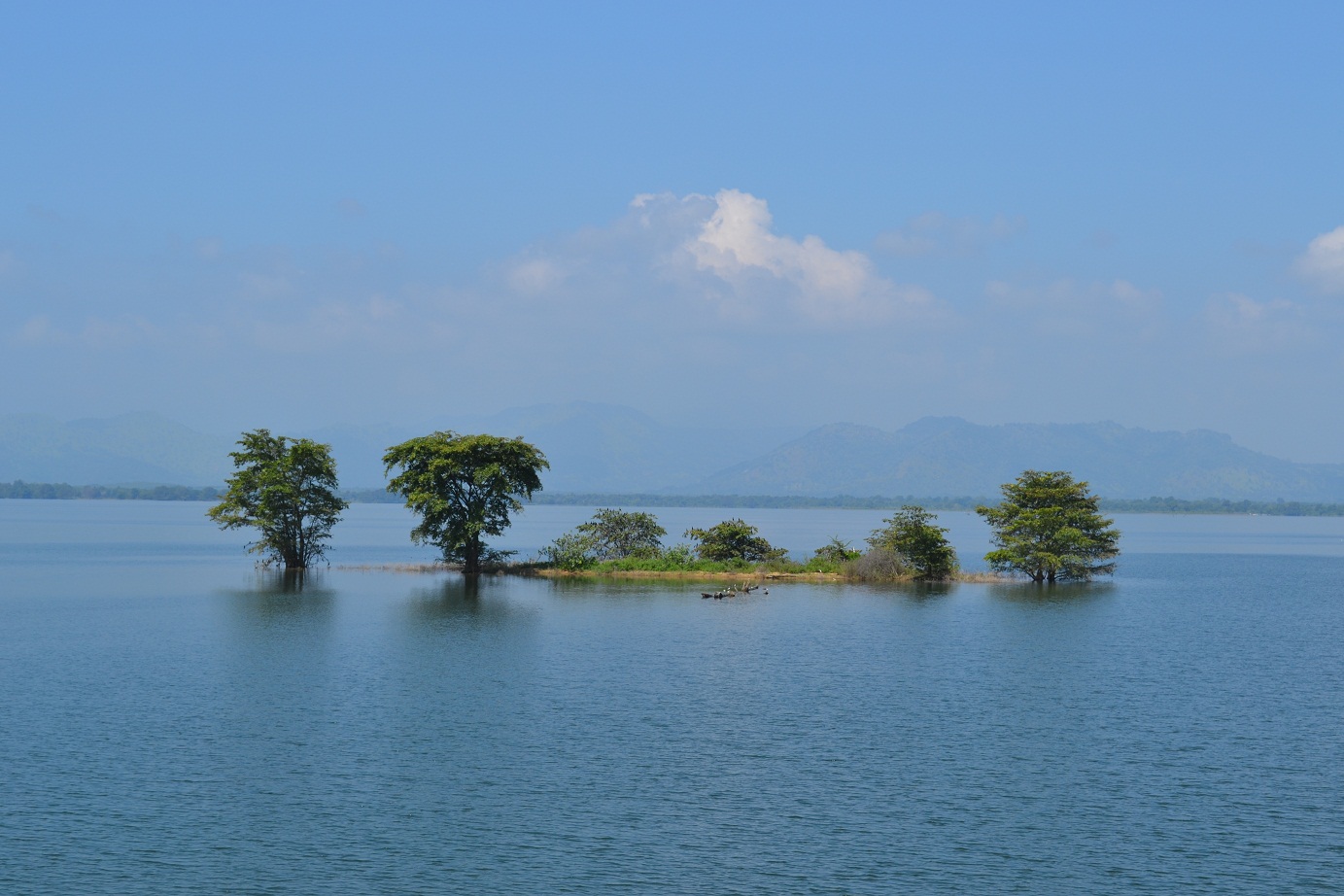
The island that is not an island.

The island that is not an island.

On a beautiful Sunday morning, I left for the Uda Walawe reservoir. I had traveled this way before, and I knew what to expect. This man-made reservoir is located within the national park’s boundaries, and is separated from the road by the electric fence. Being approximately 3400ha in size, it is a significant source of hydroelectricity, and I had high hopes for spotting wildlife. A good hour and my morning King coconut later, the first specks of reflected sunlight started to appear on the horizon between the trees. The sky was particularly clear and there wasn’t a sigh of wind. I quickened my steps, and, non-compliant to popular advice, kept walking towards the light in a steady pace. A few specks made way for hundreds, and then thousands, and with every step I gained, the view became more spectacular, as if the reservoir invited you kindly to acknowledge its splendor. Continue reading

Play Pandemonium

It was already a month ago I left Samburu!  The last day was a memorable one…

We headed out after lunch. As it was my last day, I was still hoping to catch a glimpse of cats.  I was hoping that we’d have a better chance being out in the afternoon.

Continue reading

Parting thoughts

Guest post by Michael Pardo, Cornell University

Friday, January 11, 2013

It’s hard to believe that this is my last day in the field.  The past month that I’ve spent at Uda Walawe seems to have gone by so quickly.  Part of me is eager to return to the US, where I will finally be able to sort through all the information that I have collected here.  But I do not want to leave the park and its elephants, and I resolve to savor this final day.

A juvenile plays on a mound.

A juvenile plays on a mound.

Continue reading

Recording elephants

Guest post by Michael Pardo, Cornell University

Monday, December 31, 2012

Batik

Batik and her calf

Last Monday, Sameera and I underwent a grueling six-hour bus ride (each way) to the capital city of Colombo.  Dr. Padmalal, UWERP’s collaborator for this project from the Open University of Sri Lanka, had managed to secure the approval of my research permit, and we went to pick up the document.  The long hours of sweltering heat devoid of any bathroom breaks and punctuated by the blaring of obnoxiously loud horns were worth it.  The permit allows me to record elephant vocalizations, which is, after all, why I came here.  There is only one problem:  the elephants have barely been vocalizing at all.  In fact, they seem to be doing precious little besides eating and walking.  I know that patience is key of course, but it is hard not to become a little discouraged as I wonder whether I will eventually be able to get enough sound recordings to complete my Ph.D. Continue reading