Thinking like elephants

By: Lisa Barrett, Research Assistant – Think Elephants International, Inc.
Photos: Elise Gilchrist (c) 2014, Think Elephants International, Inc. www.thinkelephants.org
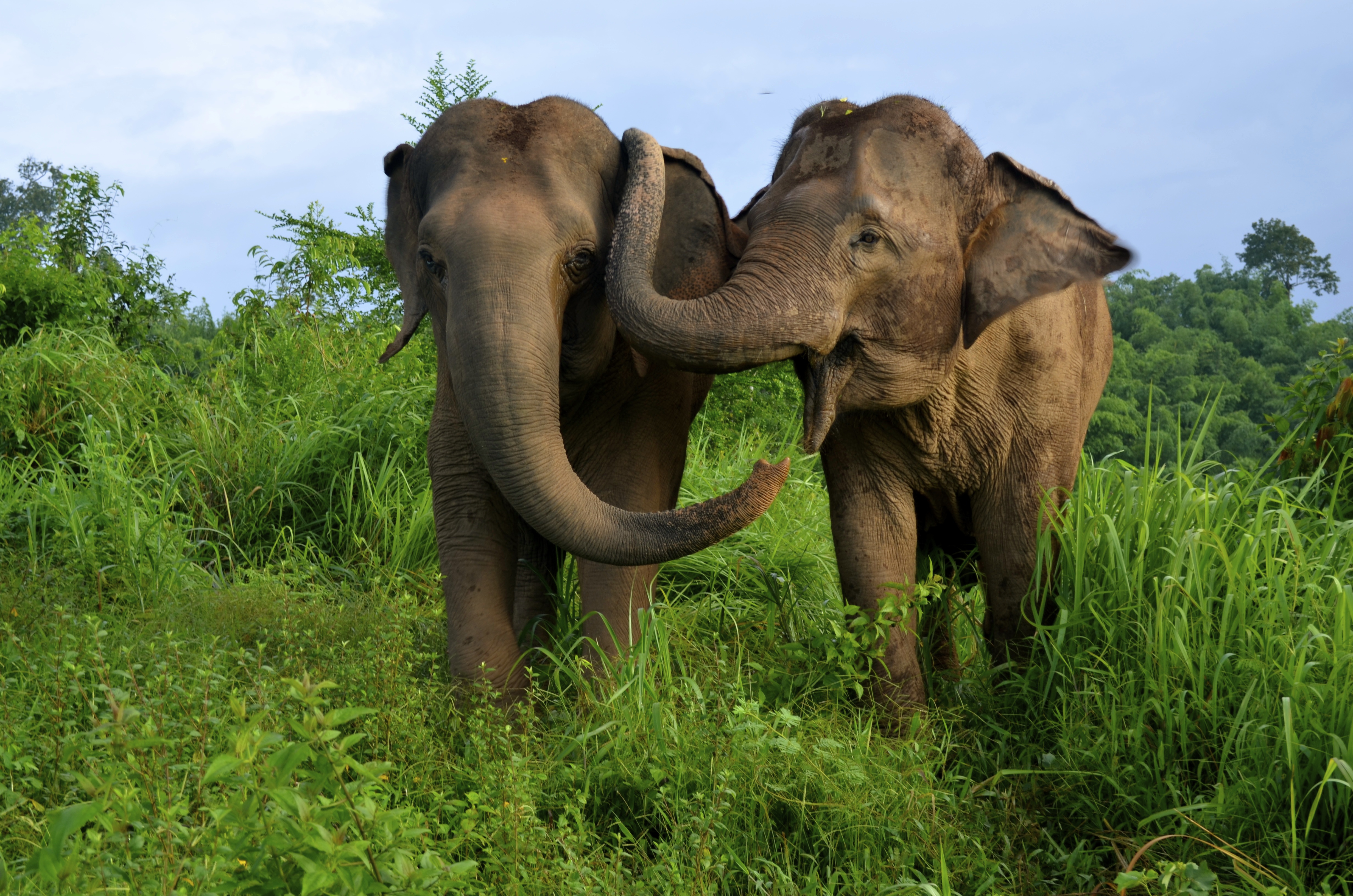
Plotnik3Think Science. Think Education. Think Elephants. That’s our motto at Think Elephants International (TEI), a nonprofit based in northern Thailand.  Founded by Dr. Joshua Plotnik in 2010, TEI’s aim is to conserve wild Asian elephants in Thailand by integrating elephant intelligence research with conservation education programming. We “think elephants” both because we think of elephants when we consider ways to help improve their conservation status, and we also think like elephants in designing our research paradigms. We use scientific research to understand how elephants “see” their world and how we can most effectively save their world. Dr. Plotnik has shown that elephants are both able to pass the mirror self-recognition task (Plotnik et al. 2006) and that they can cooperate together to complete a novel problem (Plotnik et al. 2011). In addition to demonstrating the amazing cognitive abilities of this species, we are also passionate about research that can directly impact conservation techniques to mitigate human-elephant conflict. Continue reading
Field notes

Baretail’s Tale

By TV Kumara

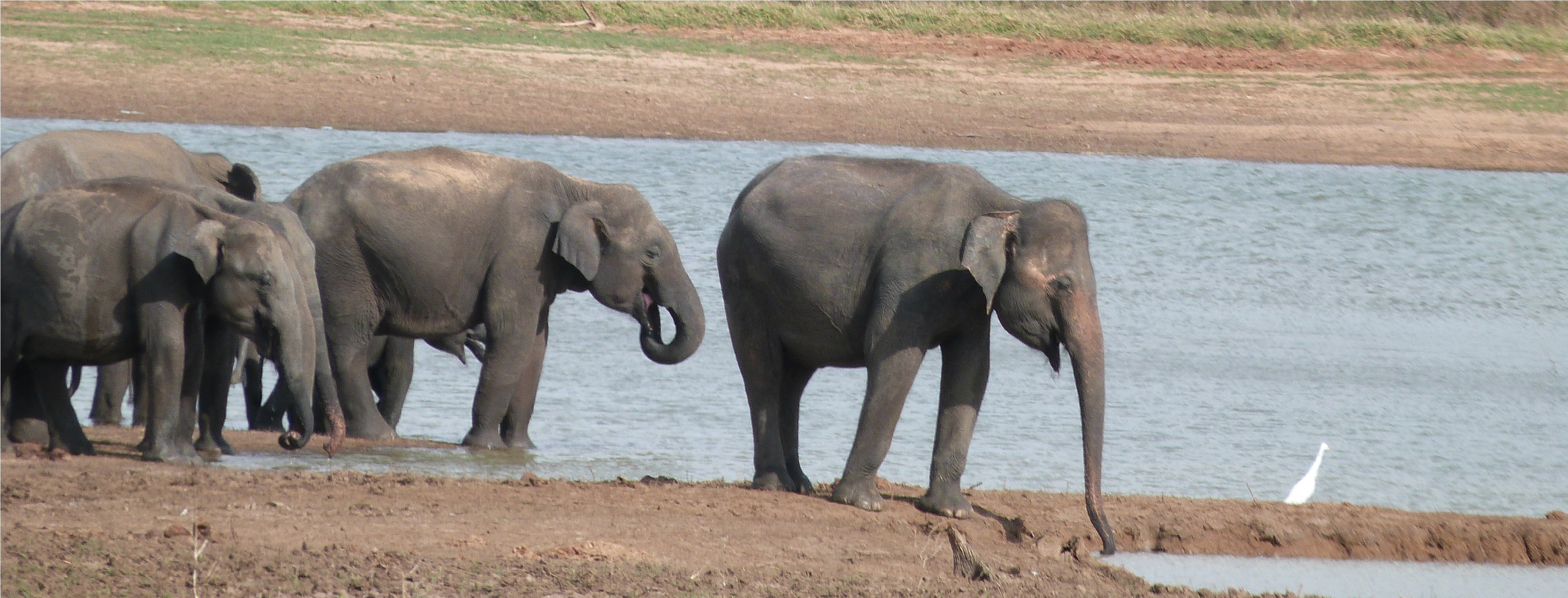
Baretail with the Bs at the Uda Walawe reservoir.

Baretail (right) with the Bs at the Uda Walawe reservoir.

Baretail is a female elephant in Uda Walawe National Park (so named as her tail has no hair). She is a member of ‘B’ unit, because ‘B’ is the first letter in names – e.g. Baretail, Batik, Bali, Bashi, Blanche, Bitsy and Bianca. Continue reading

EARS ID Database released

ears

We are pleased to release EARS (Elephant Attribute Recording System), designed by intern Ilja Van Braeckel. EARS is an MS Access database that permits quick searching of elephant ID photos. Users enter new ID features using a simple Excel worksheet which can be copied directly into Access. They can then query the database with a set of check-boxes for prominent natural features of individuals, which returns matching IDs and photos.  This should narrow the search substantially and cut down search time.  We recommend that a separate set of high-resolution ID photo files are maintained in parallel at another location and that once the search is narrowed final identifications are confirmed using these external files. The idea is for the database to aid, not replace, more detailed photos and human memory.

We share this tool freely hoping it will help others conduct individual-based studies of Asian elephants, and modifications may be made as required. Variations of it may also be useful for other species and contexts.

The database, excel sheet and a user manual can be found at:

http://trunksnleaves.org/resources.html

de Silva S, Webber CE, Weerathunga US, Pushpakumara TV, Weerakoon DK, et al. (2013) Demographic Variables for Wild Asian Elephants Using Longitudinal Observations. PLoS ONE 8(12): e82788. doi:10.1371/journal.pone.0082788

How to study social networks in elephants

Another nice summary of our work by Pleuni Pennings. Don’t forget to join us on December 21st at the Randall Museum if you are in San Francisco!

pleunipennings's avatarBeing A Better Scientist

Elephants are smart and social, and sometimes they seem very much like humans, for example when they mourn their dead. Long term research by Shermin de Silva and colleagues (BMC Ecology, 2011) showed that their friendships are also very much like ours.

Who is she hanging out with?

Shermin and her colleagues observed 286 female elephants over 20 months in Uda Walawe National Park in Sri Lanka. Every time the field crew saw one of the elephants, they noted who she was with. The data could later be analyzed using tools from network analysis.

How to recognize 286 elephants?

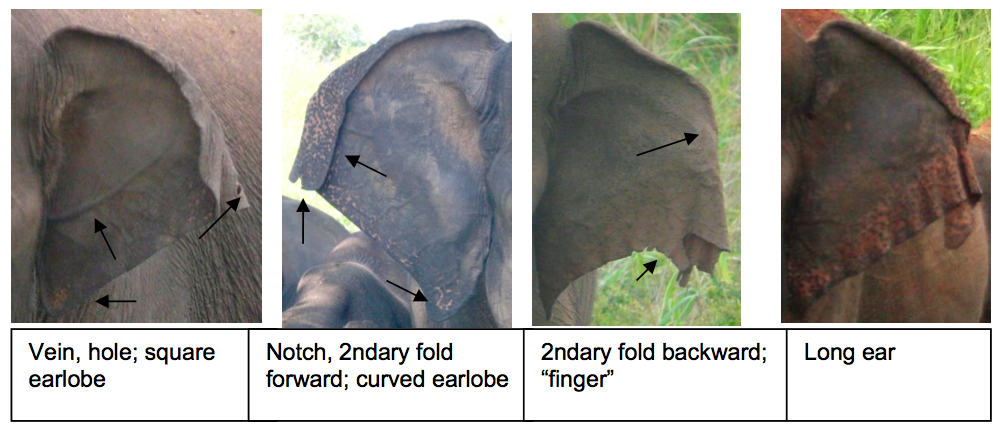
But wait a second, 286 elephants … that’s a lot of elephants to remember. You may wonder how recognizing so many individual elephants is even possible for Shermin and her crew. Well, the answer is twofold. First of all, all elephants have different ears. Second, Shermin and her colleagues…

View original post 498 more words

An Evening With Elephants

pleunipennings's avatarBeing A Better Scientist

I am trying out something new this month: I am hosting a fundraising event!

The event will take place on December 21st in San Francisco in the Randall Museum. We’ll show a BBC movie about elephants in Sri Lanka (trailer) and my friend Shermin de Silva will give a talk about her work with these same elephants.

Shermin de Silva

Shermin is an inspiring woman. She runs a field station in Sri Lanka, works in the United States (she is a postdoc in Fort Collins) and manages to raise enough money to keep her research going. This, as you can imagine, is not easy!

Her research is interesting, because she is one of few people who follows individual elephants in a wild Asian elephant population over time. Because she and her field crew know the individual elephants, they can see when elephant friendships form and break. It…

View original post 239 more words

Elephants and electricity

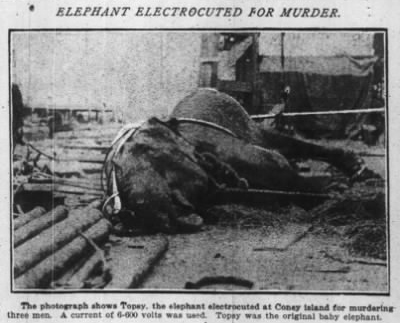
Topsy the circus elephant, electrocuted in 1903 by Thomas Edison's technicians in carrying out her death sentence while demonstrating the dangers of AC current.

Topsy the circus elephant, electrocuted in 1903 by Thomas Edison’s technicians in carrying out her death sentence while demonstrating the dangers of AC current. Photo: Chicago Tribune

By Ilja Van Braeckel

New York, anno 1903. The city stirs as dawn breaks. Woken up by the distant rumble in the neighboring tenement, you might join the breakfast table. You might appreciate your morning cup of chicory root coffee and nibble on some hard-earned buttered toast. You might scratch your head and raise an eyebrow or two as you open the newspaper and read how none other than Thomas Edison electrocuted Topsy, the 28 year female Asian elephant. You might learn how the murderous ‘beast died without a trumpet or a groan’, in Edison’s slanderous attempt to discredit his rival’s discovery of alternating current, per demonstration of its potential hazard.

Uda Walawe today, some 14 000 km and 110 years away. Neither Topsy nor Edison outwitted the tusk of time and all that remains of the unfortunate elephalectric turn of events is the original video footage and the alternating current that proved innovative. In fact, electricity is now commonly used to separate humans from other animals and this is no different in Uda Walawe, where the national park is delimited by an electric fence line. In reality, however, frequent power cuts make its efficiency questionable to say the least and the elephants, keen creatures that they are, seem to have learned to jostle over the fence poles. Continue reading

Play Pandemonium

It was already a month ago I left Samburu!  The last day was a memorable one…

We headed out after lunch. As it was my last day, I was still hoping to catch a glimpse of cats.  I was hoping that we’d have a better chance being out in the afternoon.

Continue reading