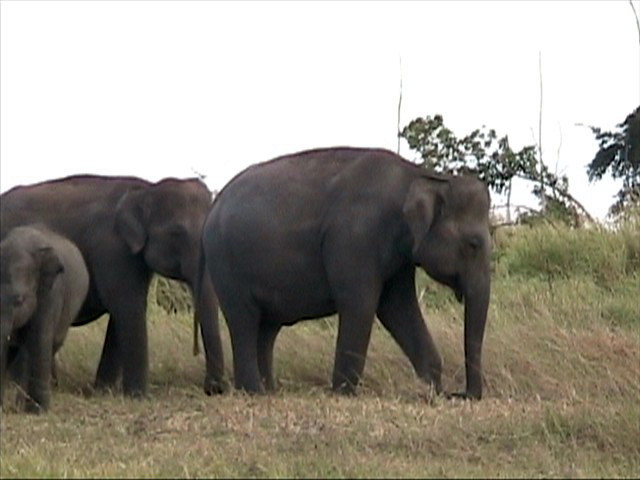
Water is something that all living things require, to varying degrees. Elephants require a great deal. Researchers in Southern Sri Lanka from the Center for Conservation Research have recently found that this dependence on water may be the key to determining whether elephants inhabit an area [1].
Author: Trunks & Leaves
Pink Elephants Do Exist
This amazing image is a computer generated composite based on ultrasound scans of an elephant in the womb, taken for a BBC documentary (They also show a baby dolphin and dog, linked HERE).
Here is what an actual ultrasound-based photograph looks like, taken at the Whipsnade Zoo. At just three months into the pregnancy, his little trunk is already visible! (Article linked HERE.)
The Elephant’s Chirp
Given the previous post about what shall now infamously be known as the incident of 2011, I thought it would be nice to lighten things up by sharing our other experiences with males in musth. Moreover, this is about one of those moments every scientist lives for: discovery.
First of all what is ‘musth’? Musth is a condition that male elephants undergo after their teens which is similar to rutting in sheep and deer, in which males spend most of their time trying to find reproductive females and battling other males for dominance. Hormonally, it means they are pumped full of testosterone. Typically a male has to be in very good body condition to enter musth, and the older he is the longer it can last – several months in some cases – and during that time he eats very little. You know a male is in musth when he shows reddish wet patches on the sides of his temples (just behind the eyes), and dribbles urine. Oh yes – and he also smells to high heaven (some of us happen to think it smells rather good, musky sweet and thick…but then again, some of us also like the smell of Durian).
Continue reading
Narrow Escape
Today we (Sameera & I) had a narrow escape from two big bulls who were in peak musth. It was the Kiral Ara road where the area is totally covered by large bushes, particularly Lantana. While we searching for elephants as usual, I smelled musth and was trying to find the musth males. There were lots of foot prints by a group of elephants and lots of broken branches by the road.
At a bend in the road I saw a big male was crossing and I managed to identify it quickly. He was in peak musth & it was [M038], one who was attacking safari jeeps in 2008. I have seen him several times close to the jeep, but he was only aggressive one time.Elephant Safety Tips
I was reading of yet another unfortunate elephant incident in India:
“According to the forest officer’s account, the elephant was crossing the road when the car reached the spot. The family of three which was moving in the car tried to drive the jumbo away. Their efforts — blaring of horns and flickering dipper — were enough to agitate the animal which in a fit of rage flipped the car.” Article at the link below.
The Elephant At Peace
Recent events, including some news I got just this morning, was the inspiration for this post. It’s dedicated to the elephant few people are fortunate to to see. I don’t mean any particular elephant – not a tusker, or some performer of odd tricks. I mean the elephant who is not raiding a crop. The elephant who is not injured by a train. The elephant who is not being shot at, or bombarded with flames. The elephant who is not charging, or fleeing, in terror. The elephant who is not trying to hide in the bushes at the first scent of humans. The elephant who is not grieving its lost calf. In short, I mean the elephant at peace. That elephant.
In Uda Walawe, as in few other places, the Asian elephant can be seen at peace. A herd drifts by in the tall grass, rustling and rippling in the breeze, as they glide smoothly like a small convoy of ships. An ear flaps with the thud of a sail unfurling. There is nothing but the sound of the wind, the birds, and the munching of many mouths.
Learning from Parakrama’s death
I did not get a chance to set eyes on the iconic Galagamuwa tusker, nor will I ever be able to. In the wake of the flurry of emails, news articles, blogs, and facebook posts that have followed this tragedy however, it is easy to get so overwhelmed by frustration that we seek out someone to blame – anyone. It would be easy to blame the vets, to blame the Department of Wildlife Conservation, to blame the villagers etc. and the list goes on. But that would be a mistake and a greater tragedy. Let this death bring about changes in the way that HEC is dealt with at its most fundamental level, not simply a witch-hunt. To that end, I’m posting information to correct some of the misinformation out there, and thoughts on where this is all going.
The Amazons
Today we spent some time among a group that we fondly call ‘The Amazons.’ They are quite simply the biggest females we have ever seen. Amazons, of course, are the famed fictional tribe of female (human) warriors. This group of elephants isn’t particularly fierce, they are just quite tall. What’s special about them is that they have a penchant for coming up to the jeep, and for all intents and purposes, appearing to fall asleep around us (standing up). It’s not entirely clear to us whether this is unique to our jeep, or whether they would do the same to any other vehicle that showed up in front of them and sat still long enough. We remember the first day we ever met this group… Continue reading
Blanche’s baby

July 28th 2006 – – –
It’s the height of the dry season, and this year the reservoir is full of elephants. Last year, they didn’t come down at all – on my very last day in August, I saw just one group crossing it in a hurry. This year, around every corner there is a large group of elephants. There must have been several hundred animals altogether, including calves. It’s almost like what I’ve read of African elephants – but these groups are very distinctly separated. The individuals in them don’t seem to be there by chance. Instead, there are certain elephants who seem to be found ‘together’ a lot of the time, though not always. Were they families? Extended families? Who knew.
Notes from the past

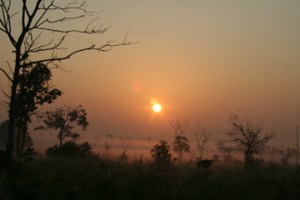
Morning mist
Jan. 25-Feb. 09 2007 – – –

![P1500314_[M038]RB1 musth](https://i0.wp.com/elephantresearch.net/fieldnotes/wp-content/uploads/2011/01/P1500314_M038RB1-musth-300x225.jpg)