10 Days Left To Help Elephants & Us!

Haven’t gotten around visiting our RocketHub fundraiser page yet?  There’s still time!  But hurry – we’ve only got till December 15th!

Many thanks to Marion Bricaud all the way from France for donating this lovely artwork (check out more of her art at http://polymorphicgirl.deviantart.com/)!

That’s what you’ll get if you donate at the $150 level (without the watermark, of course).  I’ve also added another reward at $250 – an original ink elephant drawing by yours truly!  There are lots of rewards at levels above and below this, so check them out & help us help elephants:

http://www.rockethub.com/projects/3707-helping-elephants-and-people-coexist
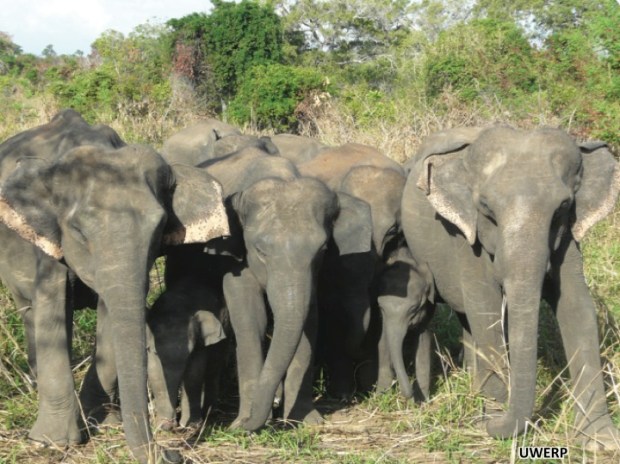
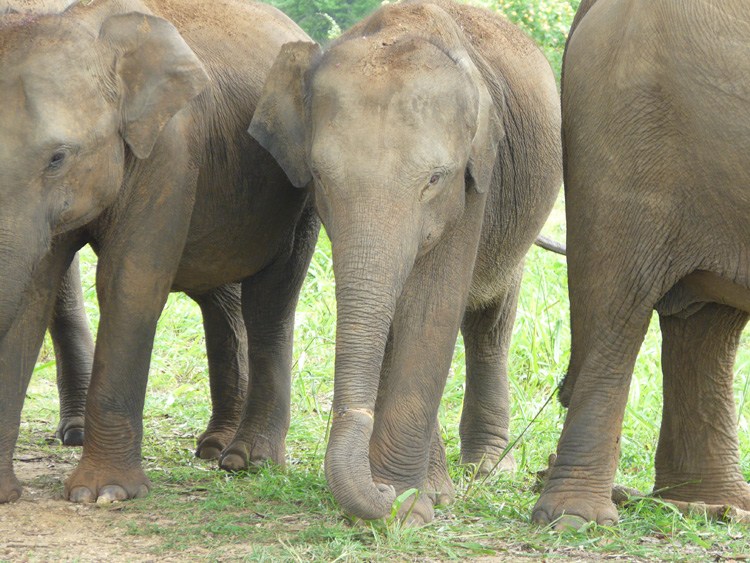
Sharing shade

I spend a lot of time looking at elephant photos.  Now and then, I see something that makes me smile.  I just came across a set of pictures from back in May of 2009, which prompted this post.

One of the neatest things about the elephants at Uda Walawe is how habituated many of them are.  What does habituation mean?  When studying an animal’s behavior, it’s important that the presence of an observer doesn’t change its behavior.  It has to go about its business as if you weren’t there – or at least, not minding your intrusion.  Unhabituated animals are fearful, and we can easily tell that some of the elephants in Uda Walawe are not used to people at all.  But others we know very well – and maybe, they know us too?

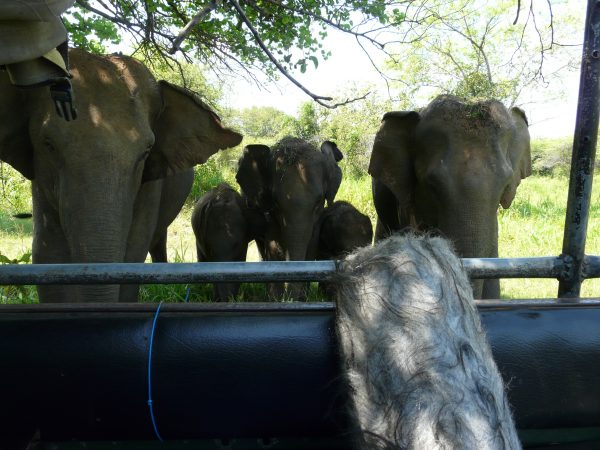
The S unit is one such group.  The ‘S’ stands for Seenuggala, which is the name of a little reservoir inside the park around which we frequently see them.  This is one of the largest social units in our study.  One hot morning in May of 2009, we came across them scattered about under trees trying to avoid the sun, as elephants do in the middle of the day.  We ourselves pulled up to some shade by the side of the road, from where we could watch them.  We knocked off the engine and waited.

The ellies and we, escaping the heat beneath the same tree.

Continue reading

We’re part of the #SciFund challenge!

There are at least two kinds of science today – a) the kind that requires millions of dollars, a small army of techs and postdocs, and many fancy doo-dats or whatsits and b)everything else. The latter doesn’t do too well in today’s funding climate, which is geared toward funding BIG EXPENSIVE science. A small group of scientists – mostly students – are trying to change all that by appealing directly to the public to fund small, very cool, science projects and earn a nifty little reward of thanks. The projects are diverse – everything from zombie fish to next-generation algae technology.  The result: The #SciFund Challenge! Help us help elephants – and help science along the way!

WANT TO HELP?

http://www.rockethub.com/projects/3707-help-us-help-elephants-people-in-sri-lanka

Please share the link above to help us reach our goal!

Check out all the other projects here:

http://www.rockethub.com/projects/scifund

The Magnificence of Mud

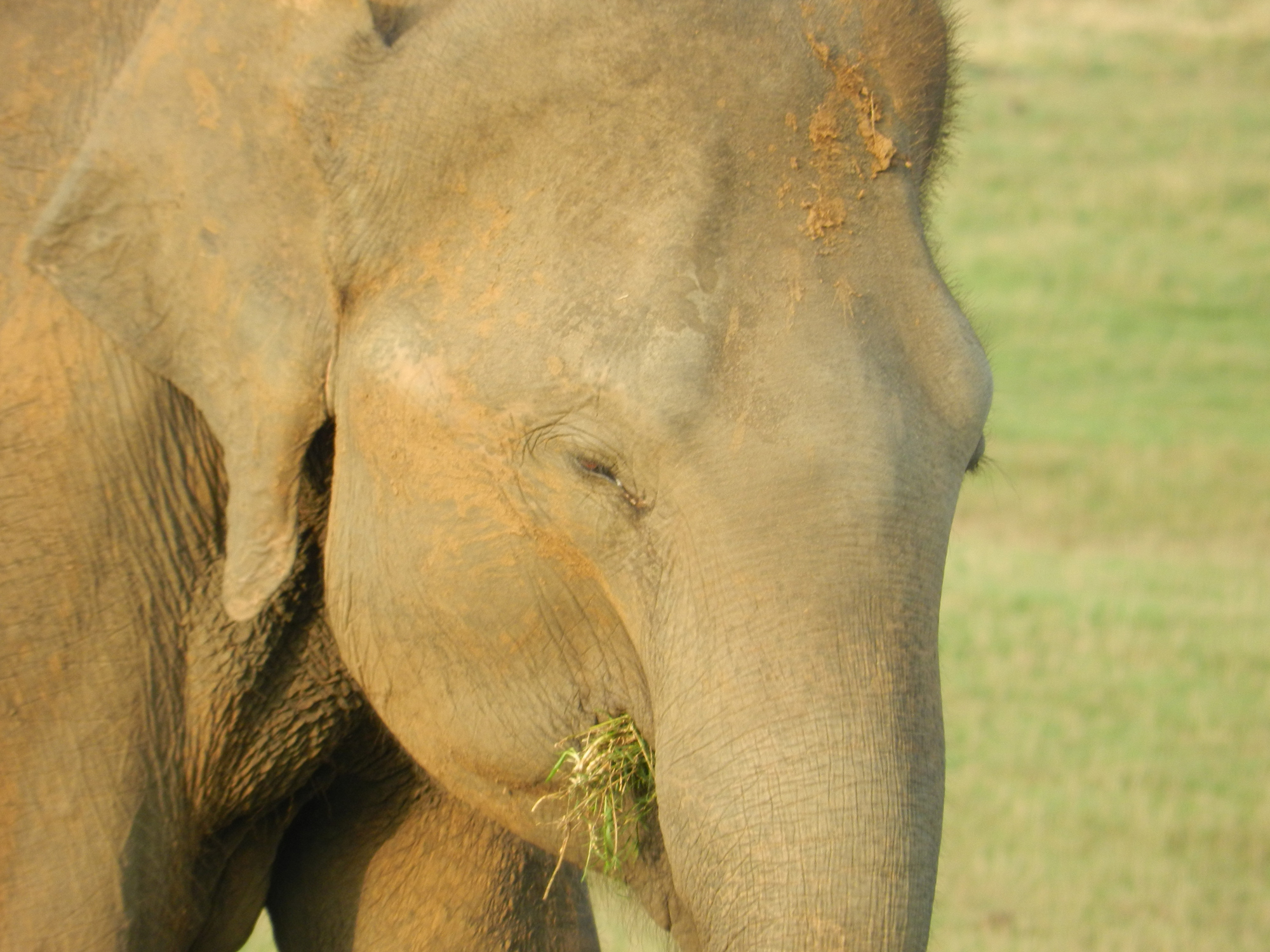
It’s October, and the monsoon is in full force.  As we wrote in an earlier post the elephants love mud.  They’re just oversized piggies with big floppy ears.  Here’s a video for your amusement:

Why do they love mud so much?  As anyone who has seen or enjoyed a muddy spa retreat can tell you, it’s good for the skin and helps with thermoregulation.  Because elephants don’t sweat, when it’s hot outside the evaporating mud cools them off.  Rudyard Kipling so mischievously wrote in ‘The Elephant’s Child’:

‘Don’t you think the sun is very hot here?’ [says the Rock Python]

‘It is,’ said the Elephant’s Child, and before he thought what he was doing he schlooped up a schloop of mud from the banks of the great grey-green, greasy Limpopo, and slapped it on his head, where it made a cool schloopy-sloshy mud-cap all trickly behind his ears. Continue reading

The Social Lives of Asian Elephants

Kanthi (far left) and Kamala (far right) were the most inseparable pair of elephants we saw during the study. Members of their social group, the K unit, were often together whenever they were seen.  Yet not all social units were so tightly knit, with individuals being scattered into small groups quite far apart.

Kanthi (far left) and Kamala (far right) were the most inseparable pair of elephants we saw during the study. Members of their social group, the K unit, were often together whenever they were seen.  Yet not all social units were so tightly knit, with individuals being scattered into small groups quite far apart.

Male and female Asian elephants form distinct parallel societies in which adult females and calves move together and form visible groups whereas adult males are typically more solitary.  For many years there have been two somewhat conflicting characterizations of female Asian elephant society.  The classic view, popularly held, is that Asian elephants form very tightly-bonded families centered around older adult females known as matriarchs.  This view is adapted wholesale from the many excellent long-term studies of African savannah elephants [1-3], which do exhibit this type of social organization. Continue reading

The Dharmaloka School Nature Society takes a field trip


The school nature society and its teachers.

It’s 6:30 am when we pull up to the school, to be greeted by a gaggle of anxious students and parents.  Today we’re taking four jeeps, five teachers, the four of us, and a little over thirty kids who are part in the schools new ‘Nature Society,’ into the park on a field trip.  The youngest is just 11 years old, while most are 16 or 17. Continue reading

On what NOT to do when exploring a backyard in Sri Lanka.

– By Lauren Snyder

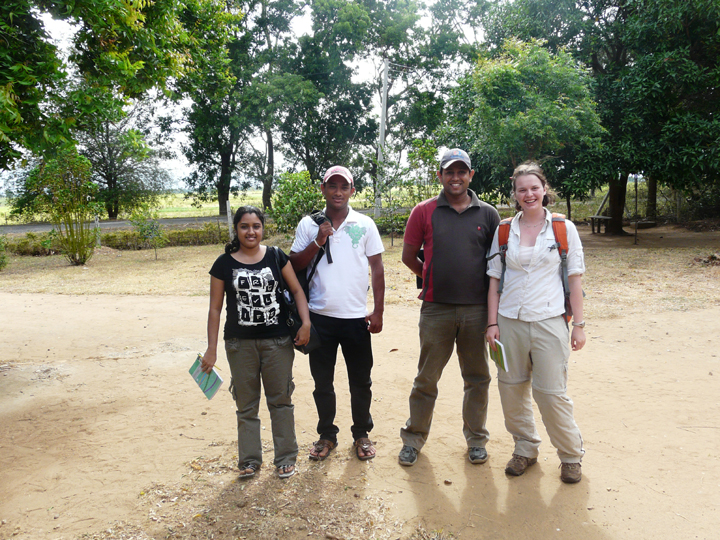
Kumari, Tharanga, Sameera and Me.

Kumari, Tharanga, Sameera and Me.

For the past month I have been visiting rural villages around Uda Walawe National Park conducting a survey on home gardens, farming habits and elephant crop raiding events. The survey team consists of Sameera, Tharanga, myself and occasionally Kumari, Ashoka’s sister. Ideally, Sameera and Kumari administer the questionnaire to the heads of household and Tharanga and I scout out the property, taking GPS points of property boundaries and gardens, and pictures of important things such as tap lines and toilets. Tharanga and I also compile a list of the crops that are cultivated on the properties. At first my identification skills were quite limited: coconut, mango, papaya, spinach, rice, and banana. Thanks to Sameera and Tharanga, I am now familiar with manioc, sweet potato, jack fruit, pomegranate, lime, orange, tamarind, drumstick, jasmine, anoda (custard apple), wood apple, ugurassa , and bread fruit. Continue reading

Endangered Asian elephants: masked crusader to the rescue!

By Lizzie Webber

Baretail's casual appearance.

Baretail’s casual appearance.

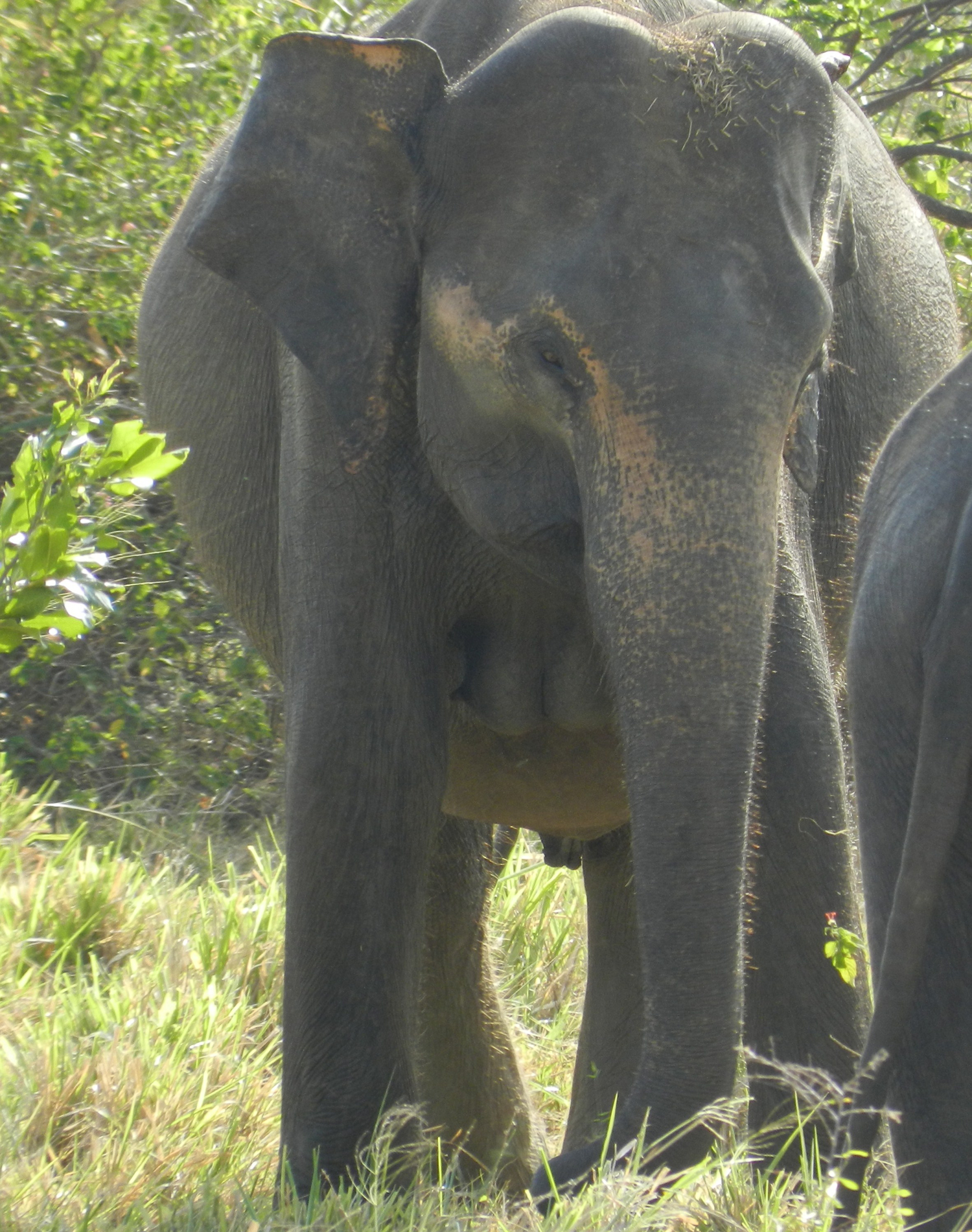
My favourite elephant has a deceptive disguise. By day, covered in mud, a pretty-looking elephant with a hairless tail, she goes (regrettably) by the name of Baretail – be careful what you nickname an elephant when you first meet, for it will stick! But by night, or after a good bath, Bare-tail’s gorgeous depigmentation is revealed, turning her into a super hero – a masked crusader!


The depigmentation around Baretai's eyes make her look like she's wearing a mask.

Baretail’s mask is revealed after a bath.

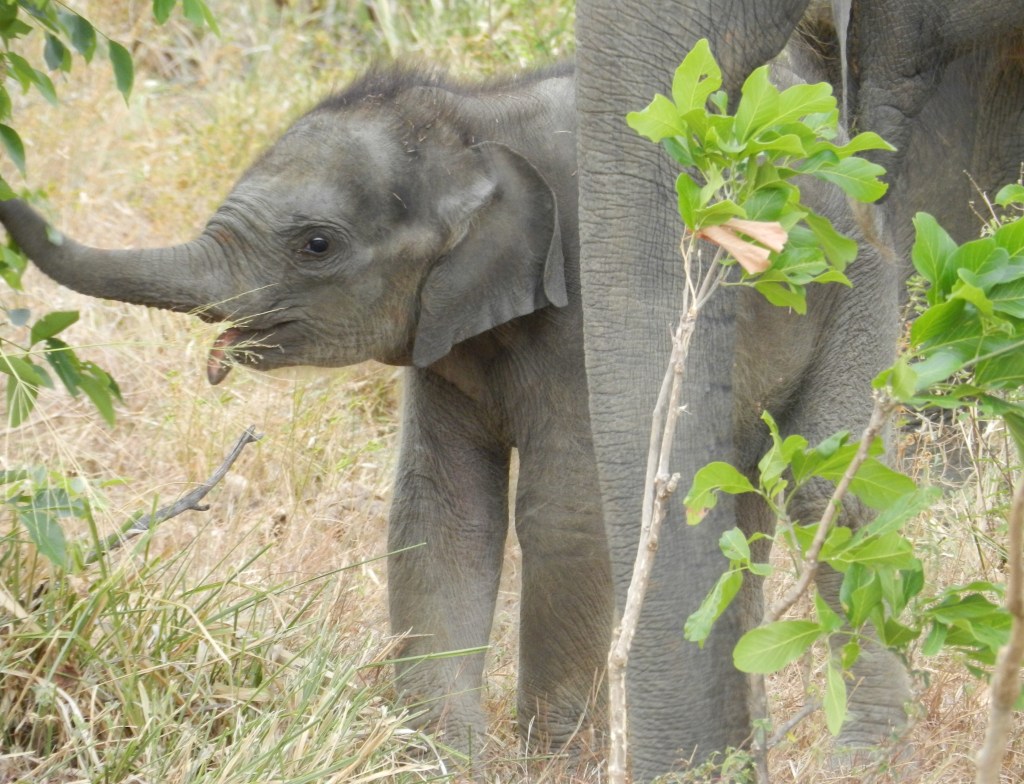
And that she is. Yesterday, the beautiful Baretail came to the rescue of the endangered Asian elephant. With extremely rough estimates of only 38,000 to 52,000 wild Asian elephants left globally, Bare-tail went through a 22 month pregnancy to give birth to a teeny little boy.  The B-unit, and the elephant population, has grown by one!

Continue reading

Rescuing elephants and wildlife from ourselves

Why is it that news about elephants is usually bad news? In light of recent posts and articles regarding injured animals, we thought it would be nice to post a happier tale and think about what it really takes to conserve elephants and the wilderness they inhabit.

A juvenile named Samanthi, with her trunk injured by a snair.

A juvenile named Samanthi, with her trunk injured by a snair.

October 31 2008. We were on the main road inside Uda Walawe.  There’s a little water hole alongside it called Ari Wala and on this day we saw some members of the Seenuggala elephants coming for a drink and a rest.  The Seenuggala elephants are so named because they are often spotted at or around the Seenuggala reservoir.  They inhabit one of the more densely forested parts of the park, where visibility is poor so we often only get to see them when they come out to get a drink. Continue reading

Lizzie has a proper ‘field day’: the first of many!

Lizzie honing her elephant ID skills on Udawalawe’s calves

By Lizzie Webber

“Maybe your camera is as excited as you!!” Ashoka teased with a huge grin as I fiddled with my temperamental camera, trying to get it to work again. Tomorrow was to be my first day studying wild elephant calves, and after a year of planning, I just couldn’t keep my toes from wiggling in excitement!!

Continue reading