2 upcoming talks by Shermin de Silva

“Elephant Social Dynamics and Conservation”
National Centre for Biological Sciences (NCBS), Bangalore
Friday Nov. 16th, 4pm

“The Spatial and Temporal Dynamics of Social Affiliations Among Asian Elephants”
Jawaharlal Nehru Centre for Advanced Scientific Research (JNCASR), Jakkur
Evolutionary and Organismal Biology Unit
Saturday Nov. 17th, 11:30am

Asian elephant imitates Korean speech

Koshik is a 12-year-old male Asian elephant housed at the Everland Zoo in South Korea.  For some years he had been a local star that was the subject of some internet fame due to his uncanny ability to produce human-like sounds.  Not only this, but they actually seemed to resemble Korean words.

In a new paper in the journal Current Biology by Angela Stoeger and colleagues, Koshik’s vocalizations were put to the test.  Could he really produce words, as trainers claimed?

The researchers recorded Koshik’s special utterances and played them back to a panel of native Korean speakers who had never heard him before. These participants did not know who was producing the sounds or what they were supposed to mean. They were then asked to write down the words they heard.  They found that Koshik’s call resembled five Korean words: ‘‘annyong’’ (hello), ‘‘anja’’ (sit down), ‘‘aniya’’ (no), ‘‘nuo’’ (lie down), and ‘‘choah’’ (good).  He appeared to be very good at reproducing the vowels in each of the words, but the consonants were more problematic.  “Choah” for instance was interpreted sometimes as “boah” (look) and “moa” (collect) by the human listeners.

Continue reading

Rainmaker

Guest post by Austin Diamond —

03 October 2012

This is Amber.  She is a grandmother.

She has three daughters.  They are all comfortably married (more or less), prefer grass to grapes, and have suffered their share of life’s sorrows and joys.

Undeniably the pride and joy of the household, at this moment, is Little One.

Little One is celebrating her first month on this planet.  Her mother and aunts are wildly protective.  As the Land Rover draws too close, they flank Little One on both sides, so that she is saved from our glances.  Still, her curiosity cannot be suppressed, as she steals a glance at us from under her mother’s belly. Continue reading

Talk on human-elephant conflict hosted by Wildlife and Nature Protection Society

***Please note change of title***

Who: Shermin de Silva

What: ELEPHANT  BEHAVIOR AND CONSERVATION: Lessons From Uda Walawe

When: July 12 2011, 6:00 pm

Where: Institute of Engineers, Colombo 07

Senate hearing on Ivory and Global Insecurity – Comments by Kate Nowak

Today there was hearing in the U.S. Senate foreign relations committee on the issue of Ivory and global insecurity,” chaired by Senator John Kerry (D-Massachusetts). In attendance were Senator Chris Coons (D-Delaware), and Senator Mark Udall (D-Colorado). Testimony was provided by Dr. Iain Douglas-Hamilton, Founder of Save the Elephants; Mr. Tom Cardamone, Managing Director of Global Financial Integrity; Mr. John Scanlon, Secretary General of the Convention on International Trade in Endangered Species of Wild Fauna and Flora (CITES).

This is a guest commentary by Katarzyna Nowak, co-director of the Udzungwa Elephant Project and lecturer in Ecology and Evolutionary Biology at Princeton University. Continue reading

Trackways freeze time to reveal ancient elephant sociality

An artist’s reconstruction of what the ancient herd may have looked like, here showing Stegotetrabelodon

The evolution of behavior is tricky to study for one very simple reason: behaviors usually don’t fossilize.  While anatomy can be reconstructed based on skeletal remains and imprints, how might one glimpse how a living, breathing organism behaved millions of years ago? Continue reading

If you’ve seen one elephant, have you seen them all?

“A horse is a horse” – but is any elephant just another elephant?

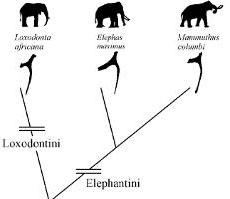
A cladogram showing the relationships between the African elephants (genus Loxodonta), Asian elephants (genus Elephas) and pleistocene woolly mammoths (genus Mammuthus) based on the hyoid bone, which is located in the neck. Figure from Shoshani & Tassy 2004.

Few people realize that Asian and African elephants are about as different from one another as we are from chimpanzees.  That’s not an exaggeration – the estimated time that they diverged from a common ancestor is about six million years ago [1], whereas humans and chimpanzees are estimated to have diverged between five to six million years ago [2].  Some have even suggested that Asian elephants may be more closely related to woolly mammoths (Mammuthus primigenius).

It’s ok if this surprises you – the elephants may appear to resemble one another more closely in appearance and sound than humans and chimpanzees.

But what about their behavior?   Continue reading

The Twilight Visit of Ghost

*Note from SdS: the following is an account based on Sameera’s experience. I’ve come to think of this mysterious tusker as ‘Ghost’ because we so rarely see him and know so little about him. The name has stuck in my head, so that’s going to be his nickname from now on.

– 27 November 2011 –

It was about 2 o’clock in the morning when I woke up to the sound of something brushing past the pipes outside. It was near the water tank. As I listened harder, I began to make out a distinctive sound – an elephant eating.

Walking over to the window, I could just make out the dark bulk of a big male. I was by myself in the field station, sleepy and tired, but very quickly I became alert. Our housekeeper, who usually sleeps on a bed on the porch, had gone home for the weekend. I was glad about this because I thought he surely would have turned on the lights and scared off our visitor.
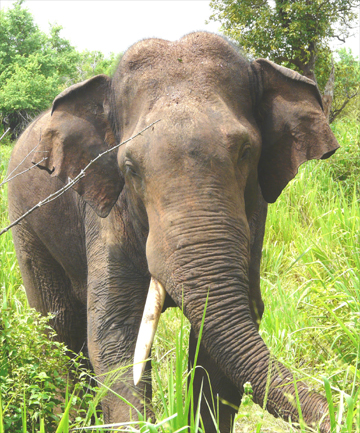
Tusker “209” which seems to have been translocated into Uda Walawe National Park in early 2010.

For months we had seen and heard evidence of elephants breaking through the electric fence, but despite numerous attempts they were impossible to find and track down once they got into the sugar cane across the road. There were at least four elephants responsible, people thought. At least one of them was a one-tusked male. We suspected it was an animal that had been translocated into the park last year, but had not been able to verify this. This was an important chance to catch one of the culprits in the act. Continue reading