By Lauren Sutton
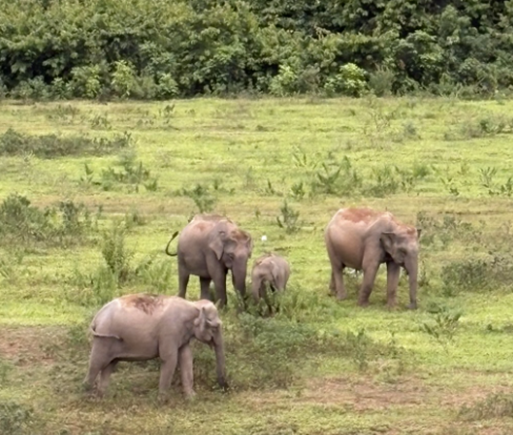
It’s late evening in Ruam Thai village, just outside Kuiburi National Park in Prachuap Khiri Khan province, Thailand. On my laptop screen, camera trap videos flicker to life: an elephant (Elephas maximus) moving slowly across farmland, a farmer checking fields with a flashlight, the quiet tension of life lived at the forest’s edge.

This is what I have seen when assisting PhD researcher Sateesh Venkatesh to analyse camera trap footage from farms surrounding Ruam Thai. The village, established by the government, sits like an island, surrounded on three sides by national park. Families live clustered in the centre, while their fields spread outward, bordering the unfenced national park, it’s a layout that leaves farms vulnerable – and elephants know it.
From Pineapples to Elephants
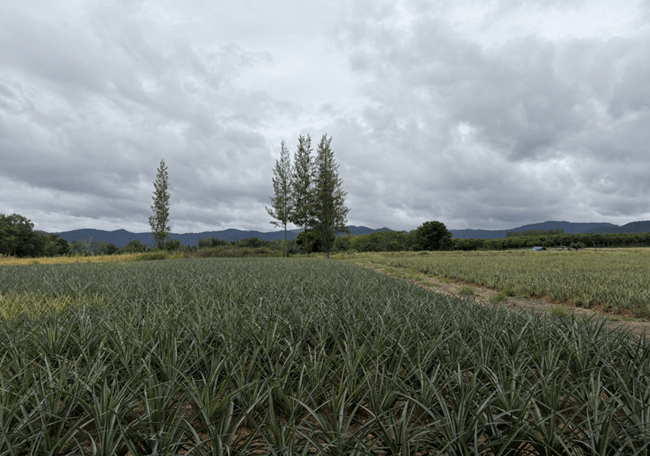
Kuriburi was declared a national park in 1999, protecting around 169 km2 of forest and wildlife (Charuppat, T., 1998). Before that, much of the land had been cleared for pineapple plantations. Pineapple is one of Thailand’s major exports: it grows year-round and provides high returns for farmers. But it also proved irresistible to elephants. Sweet and abundant, pineapples drew elephants out of the forest and into people’s fields, setting the stage for human-elephant conflict that continues today (Srikrachang, M. and Srikosamatara, S., 2005)
Exploring Alternatives
As part of the alternative crops project, Trunks & Leaves and Bring The Elephant Home partnered in 2021 to research crops unpalatable to elephants. PhD student Sateesh Venkatesh, under the guidance of Trunks & Leaves founder Dr. Shermin de Silva, researches elephant behavior using technologies such as drones to map farming areas, trail cameras to detect elephant presence and behavior, and audio recorders to monitor conflict as elephants enter agricultural lands at field sites in both Thailand’s Ruam Thai and around Udawalawe National Park in Sri Lanka.
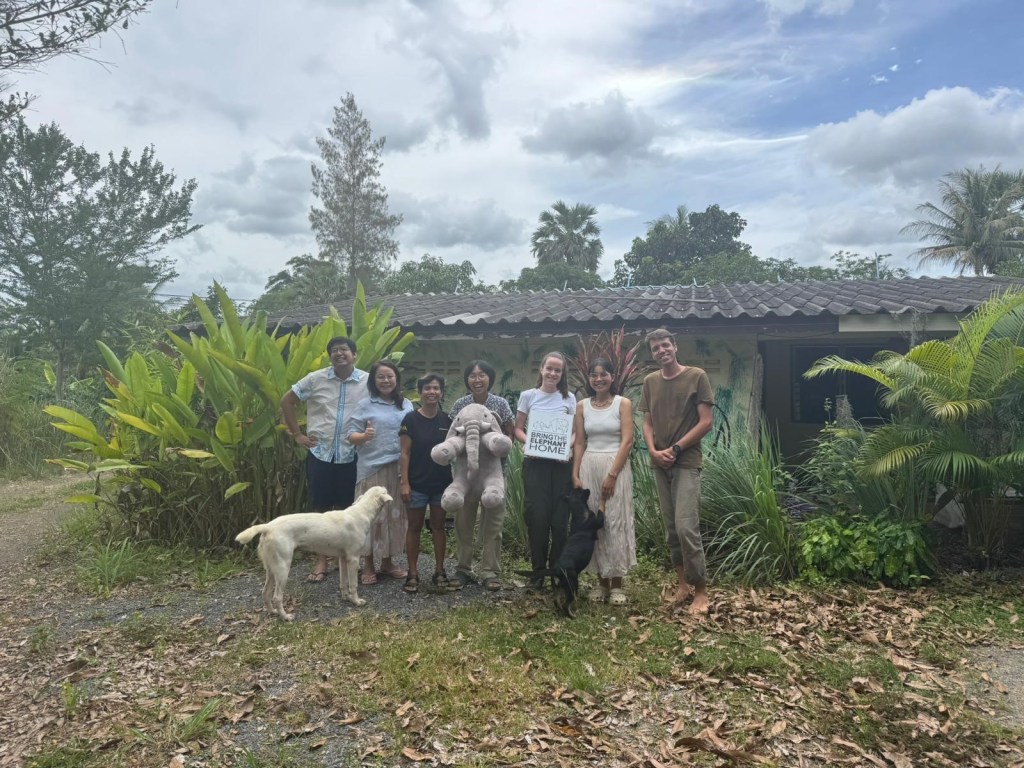
Owen and colleagues (2024) report that lemongrass and citronella are among the most promising alternative crops: elephants generally avoid them, and they offer multiple market opportunities – selling fresh at local markets, dried for higher prices (or processed in teas), or distilled into essential oils for premium pricing and products such as artisan soaps.
Yet challenges remain. Producing oil requires large volumes of raw material and costly equipment. To sell products internationally, farmers also need FDA (Food and Drug Administration – a U.S. regulatory agency) approval and stable buyers. Without reliable markets for these alternative crops, many farmers may feel pressure to return to pineapples, with their familiar low market prices and challenges such as hormone chemicals and pesticides that are hazardous to farmers’ health, even though pineapples increase the risk of crop raids as both the fruit and sweet leaf bases are highly attractive to elephants.
An Emerging Challenge: Gaur
While elephants remain the most visible and impactful species raiding crops, they are no longer the only concern alongside Kuiburi National Park. Farmers report that gaur – Bos gaurus, large wild cattle that also roam the park, listed as vulnerable on the IUCN red list – are becoming just as problematic, and in some cases more dangerous. Like elephants, gaur are drawn to easy calories in fields, trampling and consuming crops. But they can also be unpredictable and aggressive, posing direct safety risks to people who encounter them at night.
This widening conflict highlights a bigger truth: when farms border protected forest, it is not just one species but entire communities of wildlife that interact with people.
World Habitat Day: Lessons from the Forest Edge
This year’s World Habitat Day gives us the opportunity to reflect on the meaning of habitat. Too often, habitat is imagined as something separate – national parks and reserves over here, villages and farmland over there. But Ruam Thai shows that habitats overlap. The forest is home to elephants and gaur, but it is also the backdrop to farmers’ livelihoods. When the line between the two blurs, both sides feel the pressure.
Protecting wildlife habitat is not only about preserving forest inside park boundaries. It also means supporting the people who live alongside those boundaries – ensuring that their farms are viable, their families safe, and their economic futures secure. Without this balance, conservation becomes conflict, and coexistence slips further away.
Building paths to coexistence: What can help?
Science and monitoring: Camera traps and farmer observations provide crucial data where and when wildlife moves, helping to design better strategies.
Community leadership: Farmers must be central to decisions about land use, crop choices, and protection measures – as it is their livelihood that is impacted.
Support through donations and funding: Organisations such as Trunks & Leaves and their partners like Bring The Elephant Home are working directly with local communities to reduce conflict and promote coexistence. Supporting these initiatives – whether through donations, advocacy, or spreading awareness – provides the resources needed to expand research, farmer support programmes, and conflict-mitigation efforts.
A Call to Action
As I scroll through more videos from trail cameras, I see the daily balancing act in Ruam Thai: elephants searching for food, farmers striving to protect their fields. On this World Habitat Day, their story is a reminder that habitats are shared, not separate. The health of Kuiburi’s forests cannot be measured only by the wildlife within; it must also include the wellbeing of people at its edge.
If elephants and people are to coexist, we must commit to solutions that protect both wild habitats and human livelihoods. That means supporting alternative crops, strengthening community resilience, and recognising that thriving habitats are those where both people and wildlife can live.
References
Charuppat, T. (1998). Using LANDSAT Imagery for Monitoring the Changes of Forest Area in Thailand. Royal Forest Department Bangkok. 121 pp.
Owen, A., van de Water, A., Sutthiboriban, N., Tantipisanuh, N., Sangthong, S., Rajbhandari, A. and Matteson, K. (2024). The Role of Alternative Crop Cultivation in Promoting Human-Elephant Coexistence: A Multidisciplinary Investigation in Thailand. Diversity, 16(9), pp.519–519. doi:https://doi.org/10.3390/d16090519.
Srikrachang, M. and Srikosamatara, S. (2005). Elephant crop raiding problems and their solutions at Kui Buri National Park, southwestern Thailand. Natural History Bulletin of the Siam Society, 53(1), pp.87-109.
 Maximus