If you’ve seen one elephant, have you seen them all?

“A horse is a horse” – but is any elephant just another elephant?
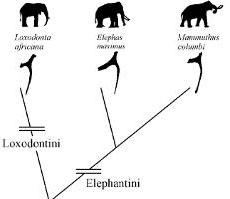
A cladogram showing the relationships between the African elephants (genus Loxodonta), Asian elephants (genus Elephas) and pleistocene woolly mammoths (genus Mammuthus) based on the hyoid bone, which is located in the neck. Figure from Shoshani & Tassy 2004.

Few people realize that Asian and African elephants are about as different from one another as we are from chimpanzees.  That’s not an exaggeration – the estimated time that they diverged from a common ancestor is about six million years ago [1], whereas humans and chimpanzees are estimated to have diverged between five to six million years ago [2].  Some have even suggested that Asian elephants may be more closely related to woolly mammoths (Mammuthus primigenius).

It’s ok if this surprises you – the elephants may appear to resemble one another more closely in appearance and sound than humans and chimpanzees.

But what about their behavior?   Continue reading

10 Days Left To Help Elephants & Us!

Haven’t gotten around visiting our RocketHub fundraiser page yet?  There’s still time!  But hurry – we’ve only got till December 15th!

Many thanks to Marion Bricaud all the way from France for donating this lovely artwork (check out more of her art at http://polymorphicgirl.deviantart.com/)!

That’s what you’ll get if you donate at the $150 level (without the watermark, of course).  I’ve also added another reward at $250 – an original ink elephant drawing by yours truly!  There are lots of rewards at levels above and below this, so check them out & help us help elephants:

http://www.rockethub.com/projects/3707-helping-elephants-and-people-coexist

We’re part of the #SciFund challenge!

There are at least two kinds of science today – a) the kind that requires millions of dollars, a small army of techs and postdocs, and many fancy doo-dats or whatsits and b)everything else. The latter doesn’t do too well in today’s funding climate, which is geared toward funding BIG EXPENSIVE science. A small group of scientists – mostly students – are trying to change all that by appealing directly to the public to fund small, very cool, science projects and earn a nifty little reward of thanks. The projects are diverse – everything from zombie fish to next-generation algae technology.  The result: The #SciFund Challenge! Help us help elephants – and help science along the way!

WANT TO HELP?

http://www.rockethub.com/projects/3707-help-us-help-elephants-people-in-sri-lanka

Please share the link above to help us reach our goal!

Check out all the other projects here:

http://www.rockethub.com/projects/scifund

The Mystery Orphan Part 4 – The Mother Appears

By Ashoka Ranjeewa

— January 31st, 2011 —

From left to right: the teenaged ‘babysitter’ from the previous week, the newborn (no longer a mystery) and Raka.

Three days later we entered the park determined to find Fat-tail. I was overcome with curiosity to know what had happened, and the team went in prepared to stay the whole day and comb through every inch of the park if necessary.

Fortunately, we managed to find the group toward mid-day. This time, it contained several more of its members – Fat-tail, Right-hole, Rani, Ramani, Rita, and five other adults. I searched for the newborn anxiously.

Continue reading

The Mystery Orphan, Part 3 – Unexpected aid

By Ashoka Ranjeewa

– January 28 2011, 6:00PM –

Once again Fat-tail, the teenager, and two juveniles rushed to the newborn who had just collapsed. It was after 6:00 pm and getting dark too. The calf had not had any food for more than 3 hours. During this same period Fat-tail and Right-hole’s own calves nursed more than 10 times. Despite their apparent concern and protectiveness, we had never seen an adult nurse any calves other than their own during the five years of the study. Possibly this was because the physical demand of nursing two calves was just too high. On very rare occasions, we had seen a female nurse two calves simultaneously, but it was very likely to be two of her own calves.

After a few minutes the newborn managed to stand and move about10m, trying to nurse continuously from her caretaker. Evidently, the calf was very weak. But before long the baby again fell to the ground. As before, the teenager and two younger juveniles gathered around her. They touched her with their trunks and tried to raise her on her feet, but it didn’t work. The baby was feebly reaching out, trying to nurse.

Continue reading

The Mystery Orphan, Part 2 – Desperate Measures

By Ashoka Ranjeewa

– January 28th 2011, 3:45 PM –

Top photo shows Rani and her calf in 2007, while the bottom shows the same calf in 2009. We wondered if Rani might be the mother of the newborn since her last calf was getting quite big.

The distance between Rani & the calf narrowed to 20m and soon they were moving parallel to each other. The calf was trying to nurse from the subadult female while continuing to vocalize loudly. But Rani didn’t come to the calf, nor did the subadult female take the calf to Rani. With time, the distance between Rani & the newborn increased again. Meanwhile Rani, Fat-tail & Right-hole all fed their own  calves. The group was now moving quite briskly, possibly because the grass was very short in that area. The calf was still keeping up, but shakily.

The group then reached an open area where lots of fresh grass was available.  They stopped moving and fanned out 80m while grazing. The most peripheral individual was Rani. While everyone was busy grazing, Right-hole’s calf, who was about 4 months old, came up to the newborn and started trying to play with her. The latter was so weak, she fell on the ground and was trampled by other youngster. Suddenly, Fat-tail and a juvenile rushed over.  Fat-tail gently separated the two by bending her head down. The little newborn went to the juvenile while Right-hole’s calf slowly moved toward its mother.

Continue reading