Borneo by boat

October 2012

Sukau, Sabah province – Borneo, Malaysia
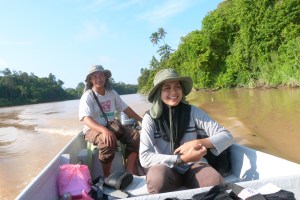
Farina_boatSukau is a sleepy little town on the eastern side of Sabah, tucked along the Kinabatangan river.  What brought me here is an unlikely acquaintance made via Facebook.  A few years ago I got a message from one Nurzhafarina Othman saying she was studying the social organization of Bornean elephants, and she had come across my thesis – could I answer some questions for her? Of course, I said, and so began a little exchange of emails about studying elephants.  I grew curious to meet Farina, who seems an unlikely candidate to be traipsing around the forest given her otherwise conservative Malay Muslim background.  Since I too come from the Sri Lankan Malay community, it seemed we had a lot in common.  Little did I know. Continue reading
Senate hearing on Ivory and Global Insecurity – Comments by Kate Nowak

Today there was hearing in the U.S. Senate foreign relations committee on the issue of Ivory and global insecurity,” chaired by Senator John Kerry (D-Massachusetts). In attendance were Senator Chris Coons (D-Delaware), and Senator Mark Udall (D-Colorado). Testimony was provided by Dr. Iain Douglas-Hamilton, Founder of Save the Elephants; Mr. Tom Cardamone, Managing Director of Global Financial Integrity; Mr. John Scanlon, Secretary General of the Convention on International Trade in Endangered Species of Wild Fauna and Flora (CITES).

This is a guest commentary by Katarzyna Nowak, co-director of the Udzungwa Elephant Project and lecturer in Ecology and Evolutionary Biology at Princeton University. Continue reading

The Twilight Visit of Ghost

*Note from SdS: the following is an account based on Sameera’s experience. I’ve come to think of this mysterious tusker as ‘Ghost’ because we so rarely see him and know so little about him. The name has stuck in my head, so that’s going to be his nickname from now on.

– 27 November 2011 –

It was about 2 o’clock in the morning when I woke up to the sound of something brushing past the pipes outside. It was near the water tank. As I listened harder, I began to make out a distinctive sound – an elephant eating.

Walking over to the window, I could just make out the dark bulk of a big male. I was by myself in the field station, sleepy and tired, but very quickly I became alert. Our housekeeper, who usually sleeps on a bed on the porch, had gone home for the weekend. I was glad about this because I thought he surely would have turned on the lights and scared off our visitor.

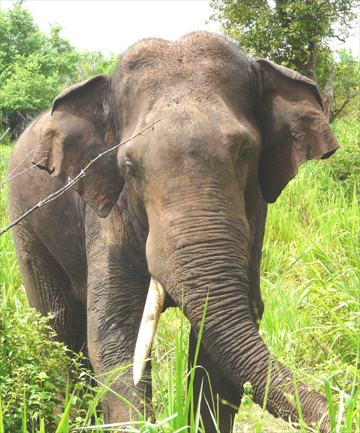
Tusker “209” which seems to have been translocated into Uda Walawe National Park in early 2010.

For months we had seen and heard evidence of elephants breaking through the electric fence, but despite numerous attempts they were impossible to find and track down once they got into the sugar cane across the road. There were at least four elephants responsible, people thought. At least one of them was a one-tusked male. We suspected it was an animal that had been translocated into the park last year, but had not been able to verify this. This was an important chance to catch one of the culprits in the act. Continue reading

The Dharmaloka School Nature Society takes a field trip


The school nature society and its teachers.

It’s 6:30 am when we pull up to the school, to be greeted by a gaggle of anxious students and parents.  Today we’re taking four jeeps, five teachers, the four of us, and a little over thirty kids who are part in the schools new ‘Nature Society,’ into the park on a field trip.  The youngest is just 11 years old, while most are 16 or 17. Continue reading

Endangered Asian elephants: masked crusader to the rescue!

By Lizzie Webber

Baretail's casual appearance.

Baretail’s casual appearance.

My favourite elephant has a deceptive disguise. By day, covered in mud, a pretty-looking elephant with a hairless tail, she goes (regrettably) by the name of Baretail – be careful what you nickname an elephant when you first meet, for it will stick! But by night, or after a good bath, Bare-tail’s gorgeous depigmentation is revealed, turning her into a super hero – a masked crusader!


The depigmentation around Baretai's eyes make her look like she's wearing a mask.

Baretail’s mask is revealed after a bath.

And that she is. Yesterday, the beautiful Baretail came to the rescue of the endangered Asian elephant. With extremely rough estimates of only 38,000 to 52,000 wild Asian elephants left globally, Bare-tail went through a 22 month pregnancy to give birth to a teeny little boy.  The B-unit, and the elephant population, has grown by one!

Continue reading

Rescuing elephants and wildlife from ourselves

Why is it that news about elephants is usually bad news? In light of recent posts and articles regarding injured animals, we thought it would be nice to post a happier tale and think about what it really takes to conserve elephants and the wilderness they inhabit.

A juvenile named Samanthi, with her trunk injured by a snair.

A juvenile named Samanthi, with her trunk injured by a snair.

October 31 2008. We were on the main road inside Uda Walawe.  There’s a little water hole alongside it called Ari Wala and on this day we saw some members of the Seenuggala elephants coming for a drink and a rest.  The Seenuggala elephants are so named because they are often spotted at or around the Seenuggala reservoir.  They inhabit one of the more densely forested parts of the park, where visibility is poor so we often only get to see them when they come out to get a drink. Continue reading

How many elephants in Uda Walawe?

This is a question that has been frequently put to us. Typically, Asian elephant numbers have to be estimated through indirect evidence, usually dung. This is because they are often found in dense habitats where visibility is poor and tracking is difficult. In other locations, such as dry reservoir beds, elephants may be plainly visible but only at certain times of year. But Uda Walawe is an exception. Encompassing large tracts of savannah-like grassland as well as forest and scrub, and having a fairly well-maintained road network thanks to tourism, the park allows researchers to watch elephants directly all-year round. This is what has given the project an unparalleled view of the lives of wild Asian elephants as they naturally live.

Age classes by size, based on calves of known age. The ‘newborn’ in this picture is actually several months old, but less than one year (click for larger image).

In the past five years the Uda Walawe Elephant Research Project has been dedicatedly following the moves of practically every elephant ever to visit the national park. It is an ongoing collaboration between Dr. Devaka Weerakoon at the University of Colombo, and Dr. Shermin de Silva, formerly at the University of Pennsylvania and now full-time director of the research program. By painstakingly photographing and identifying each and every adult, the study keeps track of who was seen, where, and when. This has given us a detailed picture of not only how many elephants there are, but approximately how many individuals there are of different ages, and at which times of year they are present.

Continue reading

Students in Sri Lanka start Pen-Pal program

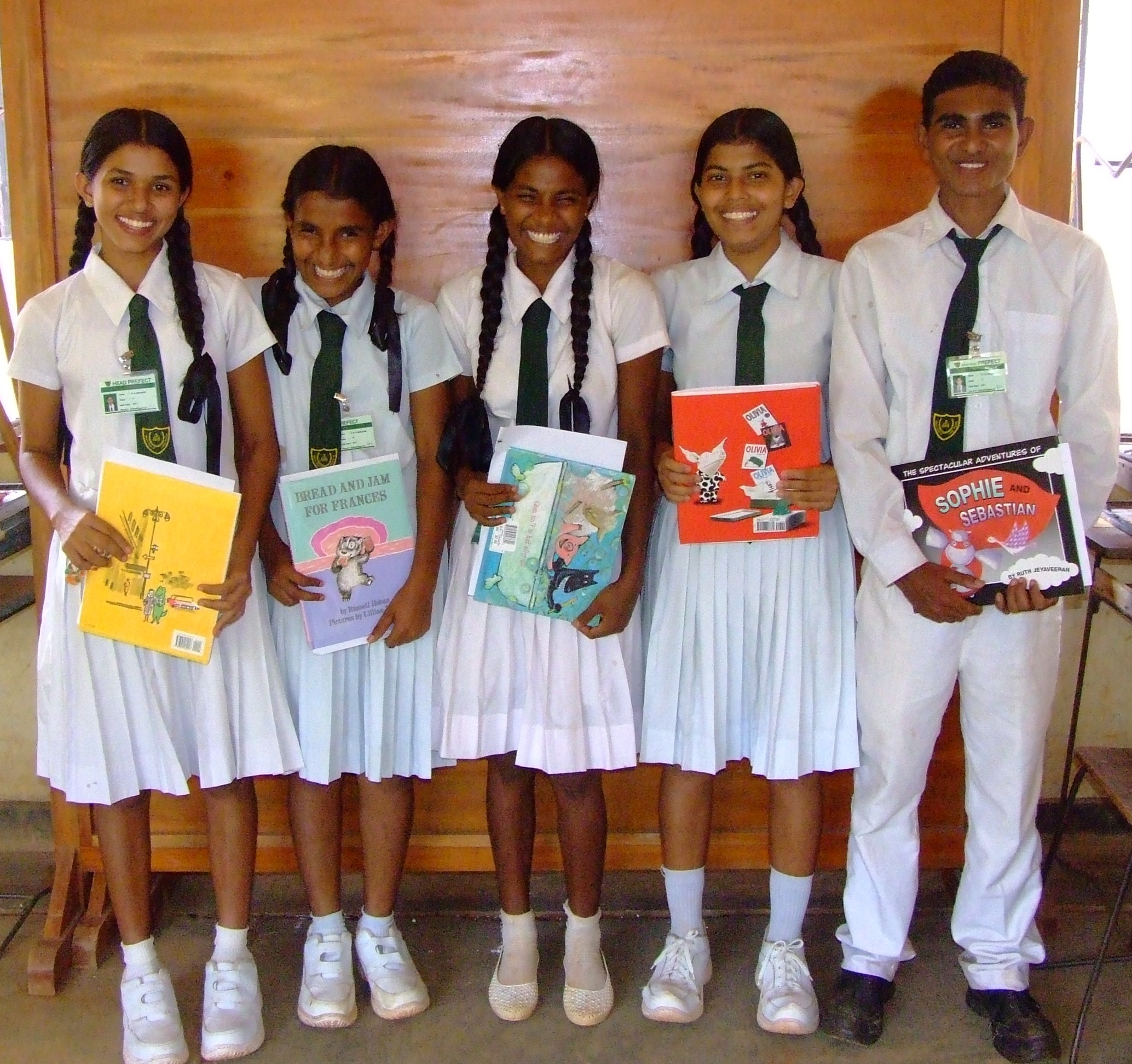
Students at Rathambalagamuwa (pictured below) and Uda Walawe have picked up the pen-pal project.  We hope this will be the beginning of many exchanges, so that students develop a one-on-one relationship with their buddies overseas.  We’ve got many ideas for future projects!

See more photos and learn about the program here!

The Pen Pal Team

Pen Pals Project Launched!

In a previous postwe mentioned a new project, “A Conversation About Conservation.”  We asked students in the U.S. and Sri Lanka if they would like to learn about one another through good-old-fashioned letters.  That’s right, pen-pals.  We wanted students to exchange thoughts on their lives and views, especially about nature and wildlife.  Happily, the response was quite enthusiastic!  Learn more by clicking here.

A ConVersation About ConServation

This slideshow requires JavaScript.

As part of an initiative to encourage young people to think about elephants, environment and conservation issues, we’re launching a new project called “A ConVersation about ConServation.”  The first high school to participate was the Cambridge Ringe and Latin School in Cambridge, Massachusetts thanks to biology teacher Paul McGuinness and other enthusiastic teachers.  CRSL is one of those rare schools to offer courses on environmental science and ecology as well, and the students, aged 15-17, were very interested in hearing about elephants.
Continue reading